


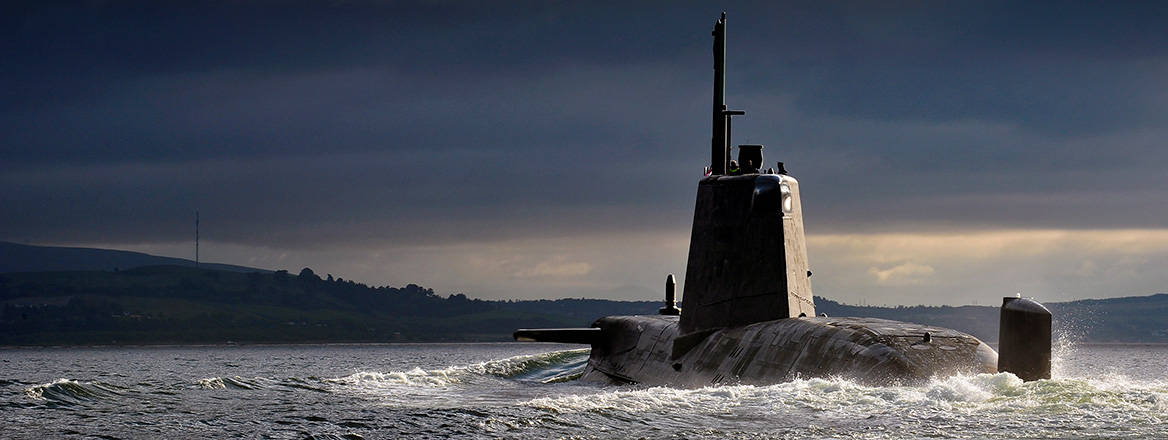
While much attention has been paid to the diplomatic fallout of the AUKUS deal, the pact has significant strategic benefits for the countries involved.
The recent defence agreement concluded between Australia, the UK and the US has been met with both diplomatic fanfare in the three countries’ capitals and a degree of understandable consternation in Paris. The focus on the diplomatic fallout of the deal has, however, obscured a more salient question: what is the concrete strategic value of the deal to its participants? Some commentators have been quick to question the wisdom of Australia purchasing nuclear attack submarines given their long build times, the numerical preponderance of China’s People’s Liberation Army Navy (PLAN) and the purported impact of technological change on the operating environment by the time Australia possesses its nuclear submarines. Such criticism often misses the point, and obscures the broader significance of a platform that can provide substantial long-term value to its participants.
The Purpose of Australian Nuclear Submarines in the Indo-Pacific: An Alliance Asset
Military-focused criticisms of Australia’s decision to procure nuclear attack submarines (SSNs) fall into four categories:
- They will be difficult to deliver in a relevant timeframe.
- Any Australian SSN force must by necessity be limited in size.
- SSNs are unsuited to the shallow littoral waters of the East Asian continental ‘first island chain’.
- Emerging technologies will render these assets obsolete.
The assumption underpinning the first objection – that Australia will operate its first nuclear submarines in the 2030s at the earliest – may well be true, though it would appear that in the interregnum the Royal Australian Navy may be able to lease a US submarine, much in the same way the Indian navy has leased a Russian Akula-class submarine while it works through the teething challenges of its own submarine programme.
More importantly, the validity of the first objection is at least partially predicated on the assumption that Australia needs its submarines now, or at least very soon. Leaving aside the fact that delivering any submarine project, whether conventional or nuclear, would have taken a substantial amount of time, this assumption is likely to be incorrect. Under current circumstances, China’s navy remains preoccupied with its immediate periphery and the US Navy needs little help dominating a subsurface contest in the Pacific. The US devotes 60% of its 51-boat SSN force to the region in peacetime – a figure that would rise in a conflict – and can in many circumstances count on the Japanese navy’s substantial force of diesel electric submarines to shoulder some regional responsibilities in East Asia. The qualitative advantages of the US Navy’s submarines and its experienced submariners vis-à-vis their Chinese counterparts, coupled with weaknesses in the PLAN’s anti-submarine warfare capabilities, mean that the PLAN currently operates under very unfavourable circumstances in the subsurface domain – something Chinese analysts acknowledge.
That being said, a combination of the imminent retirement of older Los Angeles-class boats and the relatively slow pace of construction of the Virginia-class submarine means that the US fleet will see a trough in its capabilities beginning in the late 2020s and stretching to 2041, with the force dropping to a low point of 42 boats in this period. Moreover, this will occur in tandem with growing requirements – the US Navy estimates that it will need a force of 66 attack submarines to meet its global commitments over the coming decades due to a growing Chinese and Russian threat.
This means that even when the US submarine force regains its current numerical strength, it will be short of its required numbers. It is precisely this gap between capabilities and requirements that an Australian SSN project of 8–12 submarines will help to meet. The period in which they are likely to be delivered coincides with a dip in the US’s own capabilities, allowing the allied Indo-Pacific posture to make up a capability deficit at a critical juncture.
This fact goes some way towards answering the second major objection: that Australia’s nuclear submarine force cannot match the PLAN. While this is undeniably true, it is largely irrelevant assuming that the assets are being purchased with a view to alliance commitments. Assets do not have to be unilaterally deployable in order to have a pivotal strategic effect at an alliance level. An Australian SSN force, which can remain on station for far longer than diesel electric submarines, could play a number of vital roles in any Indo-Pacific conflict. The force could contribute to an allied effort to patrol the key chokepoints of the first island chain such as Sunda, Lombok, Malacca and the Bashi Channel, thereby keeping PLAN ships and submarines hemmed within the first island chain. This is important because Chinese submarines are a key component of the sea denial system with which the PLAN would target US carrier strike groups operating in the Philippine Sea as well as vessels conducting resupply to forces in Asia. Control of key chokepoints could also contribute to a strategy of offshore control through an economic blockade, which some see as a cost-effective riposte to a Chinese offensive that begins in the first island chain.
Even in the shallow littoral waters of the Taiwan Straits – an area where nuclear submarines are not optimised to operate – they can still play an important role in supporting sea denial against PLAN vessels. The anti-ship cruise missile is fast emerging as a key component of a submarine’s anti-surface capability, with both the US and Russia leveraging submarines as launch platforms for their hypersonic prompt strike capabilities. If built with similar specifications to, for example, the Virginia submarine with its missile payload module, Australian submarines could menace high-value Chinese amphibious platforms from well beyond the first island chain. Unlike increasingly vulnerable surface vessels, submarines cannot be targeted by China’s impressive suite of theatre-range anti-ship missiles such as the DF-21D and the DF-17, making them optimal for operations in contested waters just beyond the first island chain.
Finally, it has been argued that the proliferation of unmanned underwater vehicles (UUVs), coupled with improvements to sensors and the processing of data, will make it possible for opponents to hold even stealthy submarines at risk. While it is not inconceivable that – as some argue – a future subsurface force may be comprised of a mothership operating at safe distances as a hub for smaller UUVs, it is generally recognised that SSNs, by virtue of their size, endurance and command and control suites, are the optimal platform to play this role. Any platform acting as a mothership for UUVs must by necessity be large enough to host a significant number of them and possess the space and modularity to incorporate the associated command and control suites. As an illustration of the need for size and endurance in the mothership role, one might consider Russia’s special-purpose submarine, the Belgorod – an Oscar-class nuclear submarine that was actually elongated in order to play its new role as a mothership and command vessel for unmanned assets. As such, it is not obvious that automation obviates the need for SSNs, even if it may change the role they play.
The View from the UK: Engaging to Constrain
For the UK, the deal serves three purposes: as a stimulus to industry, as a proof of concept for key parts of the UK’s new Integrated Operating Concept (IOpC) and, perhaps, as a means of building the knowledge base to speed up the delivery of the UK’s own future submarines.
While the precise contours of the UK’s role have not been specified, it is highly likely that the Rolls Royce nuclear reactor that powers the Astute– and Vanguard-class submarines will be a component of the UK’s technological contribution. The UK may also provide the technology for quiet pump jet propulsion, which is used on the Astute class. While it appears that there is an aspiration to build the submarines in Australia, the UK Prime Minister’s claim that the deal will create jobs in the UK seems to hint at some form of co-production.
In addition, the project could potentially serve as a basis for experimentation, allowing the UK to work through the complexities of incorporating its technology into an altogether new hull alongside US components even as the Royal Navy begins work on its own future SSN, the SSN(R). Collaboration and experimentation alongside foreign partners has often allowed countries to accelerate the pace of their own future projects. One might consider the example of the German Navy’s work developing the Finnish submarine force in the interwar years, which meant that even while encumbered by the military restrictions of the 1919 Versailles Treaty, Germany retained a knowledge base sufficient to rapidly produce its own U-boats when this became feasible. The reason for this was that the necessary experimentation had already been done elsewhere.
Finally, and perhaps most importantly, the deal serves as an important proof of concept for key tenets of the UK’s new IOpC. In order to adapt UK defence to an environment characterised by persistent competition below the threshold of warfare and complex relationships which combine economic interdependence with geopolitical rivalry, the IOpC introduces two critical campaigning functions to defence’s core tasks: engaging partners and constraining rivals through confrontations short of open hostilities.
Moreover, it stresses the importance of situating the military within a wider national enterprise incorporating actors in areas like industry. The AUKUS deal would seem to fit neatly within this framework. While not directly committing UK forces to confronting China – which the Integrated Review identifies as a systemic competitor and not a threat (the term applied to Russia) – the deal can nonetheless significantly constrain China’s freedom of action.
In many ways, it is likely to have a more lasting strategic impact than the transient presence of UK forces in a region where the UK has limited hard power to call on. The AUKUS framework illustrates that the UK can significantly constrain rivals without direct confrontation, even in regions where it lacks local hard power, by judiciously using its advantages in knowledge and key skills to – in George Kennan’s parlance – reinforce the resolve and capabilities of natural forces of resistance. This economy of force function should be the guiding task for parts of the UK military dedicated to partner engagement, such as the Royal Navy’s planned Southern Littoral Response Group. Indeed, one might seriously consider the possibility that in an age of limited budgets and global threats, the defence enterprise can, in many cases, primarily serve UK interests as an enabler for regional actors rather than as a direct means of resistance.
The views expressed in this Commentary are the author’s, and do not represent those of RUSI or any other institution.