

Uncrewed systems are dominating the battlespace – but how do you communicate with them, when they go beyond line of sight? This article looks at practical beyond-line-of-sight (BLOS) options now in service, and how forces are combining them to keep autonomy connected under fire.
Recent conflicts have underscored the criticality of resilient communications for uncrewed systems. In Ukraine, where drone warfare has become a daily feature of frontline operations, both sides have experienced severe disruption from electronic warfare. Commercial drones repurposed for military use often lose connectivity due to jamming or spectrum congestion. In response, Ukrainian forces have resorted to ad-hoc solutions, including fibre-optic-controlled drones and airborne relays using helium balloons to restore LOS links.
Real-World Lessons from the Drone Battlefield

These improvised methods highlight both the innovation and vulnerability inherent in current battlefield communications. The widespread use of jamming, spoofing and detection by opposing forces illustrates the necessity of systems that can operate discreetly and securely. The technologies of UK company, Spectra Group, directly address these requirements. Slingshot’s L-band signals blend into civilian spectrum noise, making them difficult to isolate. GENSS uses low-probability-of-intercept/detection (LPI/LPD) waveforms and adaptive transmit control (ATC) to mitigate jamming and interference and Troposcatter’s non-reliance on satellites eliminates a common vulnerability.
Moreover, as nations pursue AI-enabled autonomous systems capable of semi-independent operation, the ability to maintain intermittent but high-integrity communications becomes even more critical. These systems need not be under constant control but must be assured of reliable command, update and data exfiltration pathways when required. Spectra’s layered approach ensures that uncrewed platforms remain connected when it matters most.
Across the contemporary battlespace, uncrewed systems are rapidly becoming indispensable. Operating across the air, land and sea environments, these platforms are increasingly defined by intelligent autonomy and AI-driven decision-making. From precision kinetic strikes to wide-area surveillance, the value of such systems lies in their ability to operate persistently, flexibly and with reduced risk to personnel. However, one constraint underpins all their operational viability: the ability to communicate reliably, even when operating beyond traditional line-of-sight boundaries.
While civilian drone operators may panic when they lose signal and hope their platform returns automatically, for defence forces operating in congested, contested, high-tempo environments, a communication breakdown has far more serious consequences. It can result in mission failure, loss of critical assets, disastrous collateral damage or even catastrophic fratricide. As uncrewed systems become more complex, more autonomous and increasingly prevalent across the battlespace, the communication networks that support them must evolve accordingly. They must offer secure, low-latency, high-bandwidth connectivity that can survive jamming, denial and geographic isolation.
Troposcatter and TOTM: Satellite-Free BLOS Resilience
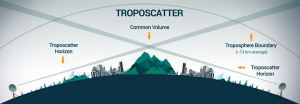
For situations where satellite communication is degraded, denied or undesirable, Spectra’s Troposcatter Family of Systems offer a powerful alternative. These systems utilise naturally occurring scatter in the lower atmosphere to transmit high-bandwidth data over distances of up to 250 kilometres, with no reliance on satellite infrastructure. The result is a resilient and secure BLOS capability, particularly suited to mobile operations and remote deployments.
The Compact Over-the-Horizon Mobile Expeditionary Terminals (COMET) and the larger more powerful Modular Transportable Transmission System (MTTS) are in active use with NATO countries and other defence forces globally. These terminals can be set up in minutes and deliver data rates of up to 210 Mbps with latency below 10 milliseconds, making them ideal for high-volume ISR data or mission-critical control signals. Their narrow, directional transmission beams make them exceptionally difficult to detect or intercept, further enhancing survivability in hostile environments.
Spectra’s latest development in this domain is its Troposcatter on the Move (TOTM) capability which was launched at SOF Week 2025. TOTM incorporates electronically steered auto-tracking antennas into a rugged, mobile form factor. This innovation enables persistent, over-the-horizon communications between mobile maritime platforms and static land-based units, even in GPS-denied or satellite-contested environments. Field trials have shown successful performance in complex littoral operations, including ship-to-shore and ship-to-ship scenarios, underlining TOTM’s relevance to both conventional and special operations forces.
Although not suitable for on the move communications in a land environment, this TOTM system has proven to be particularly effective in an On the Pause / Halt scenario on land. With pre-planned sites, this system can establish Troposcatter links in seconds saving time on setting up and tearing down of tripod based parabolic antennas. This provides instant communications and enables nodes to limit their time in a location.
Slingshot: Strategic Reach from Tactical Radios

Spectra’s Slingshot system exemplifies simplicity and effectiveness. It enables in-service VHF and UHF radios to communicate beyond line of sight by connecting them to commercial satellite networks, specifically Inmarsat’s L-TAC constellation. This transformation extends the operational reach of tactical radios from tens of kilometres to strategic distances, without the need for new hardware or complex training.
By leveraging lightweight, omni-directional antennas, Slingshot provides Communications on the Move (COTM) across manned and unmanned platforms, including vehicles, aircraft, and maritime systems. Crucially, it maintains voice and data integrity while minimising exposure to electronic warfare threats. Its narrowband L-band signal is inherently difficult to detect, jam, or intercept offering Low Probability of Detection and Intercept (LPI/LPD) performance that ensures continued operation even in highly contested electromagnetic environments.
With over 12,000 units in service globally, including 7,000 deployed by US Special Operations Forces, Slingshot has demonstrated its value in both training and combat. Its ability to coordinate fires over 600 miles within two minutes has been validated in exercises, reinforcing its suitability for controlling remote and uncrewed systems in fast-paced scenarios where traditional networks would falter.
GENSS: Adaptive Communications for Dynamic Threats
Spectra’s latest software defined radio, GENSS, represents the future of communications. Developed in the UK by a team of defence communications specialists and scientists, GENSS is designed to unify and simplify complex communications architectures.
Built with low Size, Weight, and Power (SWaP) considerations, GENSS is ideal for integration into uncrewed systems or mobile command platforms. Its open architecture and modular design allow for rapid waveform upgrades and integration with new data protocols. It also offers advanced features such as adaptive modulation, dynamic spectrum management and native MANET (Mobile Ad Hoc Network) support.
Importantly, GENSS was successfully trialled alongside Slingshot in 2024, demonstrating its ability to backhaul ATAK, voice and data traffic over satellite using in-service tactical radios. This integration enables uncrewed systems to form part of a broader mission network, coordinating in real time with command elements, ISR platforms and other autonomous assets.
This is the context in which Spectra Group’s existing portfolio of communication technologies can solve this emerging capability gap. Building on a foundation of operationally proven systems, the company delivers three distinct but complementary capabilities: Slingshot, a satellite-enabled in-service tactical radio range extension system; GENSS, next generation Slingshot based on a highly adaptable software-defined radio system designed to create and manage network operations, and Troposcatter with the new Troposcatter on the Move (TOTM) solution to provide strategic over the horizon high bandwidth data communications. Together, they provide a layered, resilient and adaptable network architecture that can be optimised to enable uncrewed and autonomous systems to perform effectively and securely beyond line of sight and while on the move.
Keeping Autonomy Connected
As uncrewed systems take on greater roles across the modern battlefield, they require communications architectures that are as adaptable and resilient as the platforms themselves. From coordinating loitering munitions over hundreds of kilometres to supporting naval drone swarms in contested archipelagos, the challenge is consistent: maintain secure, BLOS communications in the face of hostile electronic environments.
Spectra Group meets this challenge with a mature, proven and forward-looking portfolio. Slingshot enables global voice and data using legacy radios and GENSS delivers agile, software-defined flexibility to enable future tactical architectures. Troposcatter and TOTM provide satellite-independent, mobile connectivity over vast distances. Together, they allow defence forces to unlock the full potential of autonomous and uncrewed systems without compromising on security, reliability or simplicity.