

Richard Turner, SkyKeeper Business Development Manager, Lockheed Martin UK, Ampthill gave an update on Lockheed Martin’s offering of its SkyKeeper BMC4I solution for the UK MoD’s GBAD, Serpens and Zodiac Requirements.
“We have been working on a number of key incremental software upgrades to the existing SkyKeeper system to bring its performance in line with the MoD’s new Requirements to meet the wide range of targeting threats on the modern battlefield, much of which is fuelled by ‘lessons learnt’ from the Ukraine War and the increased use of drones. One key benefit of SkyKeeper is that it is built on an Open Architecture framework which also has the benefits of plug and play with other systems as well as being ITAR-free and with UK IP as well as UK MoD owned IP. One of our key partners in this upgrade Programme is 16 Regiment Royal Artillery, part of 7 Air Defence Group, based at Thorney Island. The upgraded SkyKeeper system will be demonstrated at the 7th Air Defence Group GBAD Expo in July.” Richard Turner said.
SkyKeeper Background
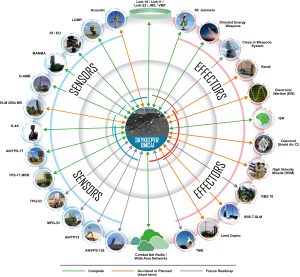
SkyKeeper is a fully flexible and adaptable BMC4I solution for the digital battlespace. It is a key Battlespace Situational Awareness, Ground Based Air Defence (GBAD), C-UAS and CRAM C2 capability, which can be integrated with almost any type of effector, both kinetic and non-kinetic, providing automated engagement solutions across all threat spectrums. SkyKeeper acts as the single source of truth in a complex battlespace where multiple sensor and other information sources must be carefully coordinated to work together for best effect, where achieving the right level of situational awareness, intelligence and engagement capability for the Land Commander is a crucial discriminator. SkyKeeper is the backbone for the UK’s Land Environment Air Picture Provision (LEAPP) LEAPP entered service in 2014 then completed its C2 upgrade programme to SkyKeeper standard in the last quarter of 2023, comprising of 5truck-mounted Control Modules with 3 trailers.
LEAPP
Land Environment Air Picture Provision (LEAPP) is a UK sovereign Command and Control (C2) capability developed for the British Army by Lockheed Martin UK to provide a Recognised Air Picture (RAP) into the land domain. By ensuring the right data, is presented at the right time, and in the right place, LEAPP provides operators at all levels with the ability to efficiently and effectively coordinate, plan, decision make and strike.
LEAPP is an operationally proven capability that exchanges real time data via multiple Digital Data Links (DDLs), including Link 16 (the military’s tactical data link network used by NATO) and can seamlessly plug into the wider UK defence digital backbone. The upgraded system that now uses SkyKeeper software and core Publish and Subscribe ‘Plug and Play’ architecture, brings operational advantage, enabling military platforms across multiple domains to exchange a tactical picture in real-time; LEAPP has now become a real game changer in the battlespace as a true Multi Domain Integration enabler.
“The success of any mission relies heavily on integration, intelligence, surveillance and data. Data, as we know has become more and more critical within the battlespace. It drives decision making. Real time data is indispensable in today’s complex and congested environment – the right level and timely situational awareness is key to precise and efficient decision making. Lockheed Martin’s Land Environment Air Picture Provision (LEAPP) capability does exactly that. By streaming real time, filtered data direct to the user, LEAPP provides operators at all levels with the ability to efficiently and effectively coordinate, plan, decision make and strike.
“The UK sovereign capability, designed by Lockheed Martin UK for the British Army has brought fundamental change to land environment operations since it came into service in 2015, and remains successfully operational today. The capability provides a Recognised Air Picture (RAP) into the land domain. SkyKeeper enabled LEAPP can facilitate seamless interoperability and evolution with both legacy and future sensors, communications and weapons systems for many years to come. Added to this, SkyKeeper’s flexible Form Factor will ensure that the capability remains relevant and unconstrained by future doctrinal changes. And having said all that, even the Sky is not the limit for SkyKeeper; true Multi Domain Integration must include all domains: Air, Land, Sea, Space and Cyber. SkyKeeper’s inherent Modular Publish and Subscribe design secures its position at the centre of the future digital battlespace, connecting the disparate dots and ensuring the right information, is in the right place, at the right time, to guarantee the right decision.”
Sky Sabre has replaced Rapier, which served the UK Armed Forces for more than 40 years. It is composed of three main elements: “the brain,” “the sensor” and “the missile system.”
“The brain”, supplied by Rafael, refers to the Surface to Air Missile Centre (SAMOC) command and control system. This includes the Link 16 tactical datalink that allows Sky Sabre to communicate with Royal Navy and Royal Air Force ships and aircraft, as well as UK allies.
“The sensor”, supplied by Saab, is the Giraffe Agile Multibeam (GAMB) radar, which provides 360-degree coverage over a range of up to 1,200km.
The Land Ceptor launcher and missile system is supplied by MBDA and fires Common Anti-Air Modular Missiles (CAMM) missiles. Sky Sabre is so accurate it is capable of hitting a tennis ball-sized object travelling at the speed of sound. It is so sophisticated it can control the flight of 24 missiles simultaneously while in flight, guiding them to intercept 24 separate targets. Sky Sabre was delivered by DE&S to the Royal Artillery (RA) in 2021.
It is operated by 16 Regiment Royal Artillery, part of 7 Air Defence Group.
“What is the current role for SkyKeeper?” The Editor asked.
“SkyKeeper is currently the BMC4I component of the UK MoD’s Land Environment Air Picture Provision (LEAPP) capability and has been in service since December 2014, excelling on deployed operations. Furthermore, SkyKeeper’s in-built Sense and Warn system provides an operationally proven, advanced and deployable base protection capability, that was successfully deployed in Iraq and Afghanistan, where it provided 24/7, high availability, high reliability protection of UK and Allied Forces. The current SkyKeeper system already meets 70% of the new requirements.” Richard Turner said.
“What are the details of the SkyKeeper solution proposed for these new requirements?”
“SkyKeeper will be advanced as the BMC4I backbone for Lockheed Martin’s new ‘GBAD Family of Systems’ concept; effectively a single integrated GBAD solution designed to be interoperable with multiple modern, future, and legacy systems, sensors, and effectors. However, SkyKeeper’s potential utility does not stop there; it has the capability of performing the C2 task for a host of additional battlespace missions and requirements that would see it grow and evolve into the BMC4I spine for land forces and beyond, playing an important role in the Joint Effects and Air Land Integration arena, whilst enhancing wider MDI/MDO. In summary, SkyKeeper is an operationally ready and cost effective BMC4I capability that meets the ever changing threat and operational requirements for Allied nations.”
UK Land GBAD Programme
The UK Land GBAD Programme was launched in 2022 in response to the Army’s requirement for a fully integrated Air Defence system of systems.
“This is a Category A Government Major Project Portfolio (GMPP) programme. This will be an enduring capability that will be delivered through incremental capability uplifts over the next 10 years.”
The identified ‘Single Statement of User Need’ for Land GBAD is stated as:
“Land GBAD must provide sufficient, effective capability to warn, inform, deter and defeat all air threats (including aircraft, missiles, munitions, and UAS), in order to prevent adversary interference from the air inhibiting Joint Force freedom of manoeuvre. Land GBAD will provide lethal and non-lethal defeat mechanisms and minimise the risk it presents to friendly and neutral air users. It will be deployable on multi-domain operations, integrated, scalable up to divisional level, and in joint and multi-national operations to Protect, Engage, Constrain and Fight.”
Identified capabilities to be delivered and enhanced by the Land GBAD programme include:
- Short-Range Air Defence (SHORAD);
- Medium-Range Air Defence (M-RAD);
- Counter Small Aerial Targets (C-SAT) for SHORAD and MRAD; and
- All Arms Counter Small Uncrewed Aircraft Systems (All Arms C-sUAS).
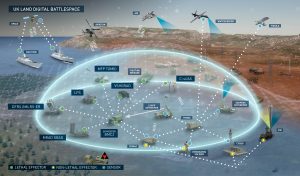
These capabilities will be incrementally delivered as a multifaceted and multi-layered programme over a 10-year period.
“Aerial threats to be targeted range from Class 1 Unmanned Aircraft Systems (UAS) including swarms, artillery, munitions, Attack Helicopters and Fixed Wing Aircraft, with potential for larger munitions and the introduction of future novel weapons.”
There are 3 current stages of the Land GBAD Programme. Partners include MBDA (missiles) , Saab (Giraffe and MX-1 C-UAS radars), Rafael, Thales and Lockheed Martin.
- Involves the integration of the Sky Sabre system and the new Thales SHORAD system to replace Stormer (OSD 2027). Thales is developing its’s own SHORAD C4 solution which will integrate seamlessly into SkyKeeper. A later development will include the integration of the CAMM missile systems which will bring the range to 40km from the current Sky Sabre’s 25km.
- 7th Air Defence Group will integrate upgrade C2 Systems. This is expected by the end of 2025 early 2026. 7th Air Defence Group will support 3 Div providing layered GBAD Capability with all air defence assets being integrated.
- The third Increment is not funded. This involves more layered integration of systems
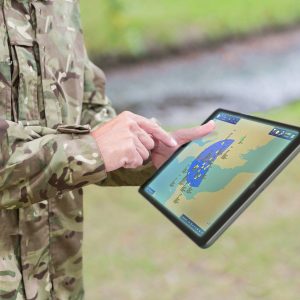
“To meet the new Requirements, we have developed SkyKeeper into four new Form Factors, from a truck mounted systems to a Tablet / iPad data for infantry use. SkyKeeper is also available in various form factors, designed to meet our customers’ specific requirements and operational needs.”
SkyKeeper Command – Tactical Operations Centre; Operator consoles installed in an ISO container, fixed building or location.
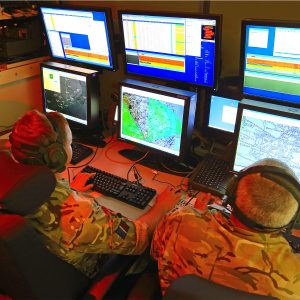
SkyKeeper Manoeuvre – Fully integrated into military vehicles’ operating systems through the General Vehicle Architecture.
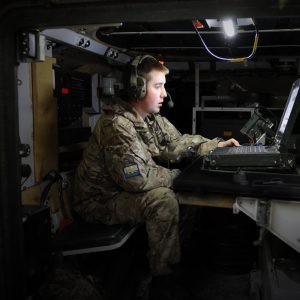
SkyKeeper Flex – Ruggedised Laptop and server case configuration; fully transportable and rapidly deployable using any type of vehicle. Ability to operate from austere locations, semi-prepared buildings or tented facilities.

SkyKeeper Edge – Tablet / iPad data for use by the dismounted soldier.
SERPENS
SERPENS is the MoD’s next generation weapon locating system with a digitally networked suite of sensor systems that detect hostile mortars, artillery and rockets. SERPENS will provide a replacement for the current Saab MAMBA weapon locating radar.
The UK MoD introduced its quest for a next-generation weapon locating system (NGWLS) in 2018 at a time when fighting between Russia and Ukraine had already been ongoing for four years in the east of the country with Crimea in Russian hands during that time.
Then, in 2019, the NGWLS was renamed Project SERPENS under the control of the MoD’s DE&S organisation. SERPENS would also, according to the MoD, become part of the ZODIAC future Land ISTAR system, designed to gather information from all battlefield sensors to deliver comprehensive, effective and actionable intelligence for friendly forces.
Lockheed Martin sees SkyKeeper as a SERPENS solution. Other companies offering systems include Babcock and IAI. Babcock and Israel Aerospace Industries (IAI) will offer IAI-ELTA’s Compact Multi Mission Radar (C-MMR) system for SERPENS, the MoD’s next generation weapon locating system.
Zodiac Programme
On 12 September 2023, Roke, a UK based Prime Contractor, signed a £40m contract to deliver the next two years of Project ZODIAC for the British Army. ZODIAC is the backbone of the Army’s Land ISTAR Programme, and will deliver an integrated Intelligence, Surveillance, Target Acquisition, and Reconnaissance (ISTAR) system, which will transform how the Army undertakes data-led decision making in the Land environment to gain operational advantage.
As the Prime Systems Integrator for the project, Roke will integrate sensors, deciders and effector systems to deliver a Minimum Viable Product (MVP) ISTAR system that will operate in the Degraded, Denied, Intermittent and Limited-Bandwidth (DDIL) communications environment of the modern battlefield.
Through an Agile delivery approach, with development informed by user engagement and training exercises, ZODIAC will provide an integrated and distributed system of applications and underlying system architecture that will enable the Army to understand, decide and act with greater precision and speed and digitally integrate with key allied partners. The system will be complemented by a software and data DevSecOps pipeline to enable rapid enhancement, long term system evolution and the management of pre/post mission data loads. This pipeline will be key to transforming how the Army operates.
Aligning with the goals set out in the most recent MoD’s Defence Command Paper, Roke’s work on this project will be integral to digitalising the Army’s Sensor-Decider-Effector chain, contributing to faster decision-making, lower cognitive burden on operators, and more efficient use of the Army’s resources. ZODIAC will provide the platform for the introduction of artificial intelligence (AI) into the Army’s ISTAR processes, increasing the quality of decision-making and speeding up the tempo of operations. ZODIAC will contribute to the UK MoD’s objective of achieving Digital Deterrence: realising a strategic deterrence effect through digital advantage.
Roke will work closely with a trusted consortium of industry partners comprising 6point6, General Dynamics Mission Systems – United Kingdom, Nexor, QinetiQ, and Sierra Nevada Corporation Mission Systems UK Ltd, to advance the ZODIAC project, ensuring that the Army can take advantage of industry’s foremost technical capabilities on a continuous and enduring basis.