

Drones, Depth, and the New Vulnerability
The saturation of the modern battlefield with Uncrewed Aerial Systems (UAS) and their increasing reach into depth has altered the character of warfare, redefining combat and soldier vulnerability. But the increasing capability and density of UAS countermeasures on the frontlines has also driven the UAS threat further back into the operational and strategic rear areas, once thought relatively safe, as illustrated by Operation Spider’s Web. This shift dovetails neatly with Russia’s hybrid approach to high-intensity conflict, combining conventional operations with information, cyber and covert warfare, and economic coercion.[i]
In addition, Western responses have focused on automating frontline combat, displacing human command elements further back which has simply shifted the target set: adversaries inevitably strike where people and command infrastructure remain. Protecting the whole force, not only the fighting edge, must therefore drive capability design.
The Limits of Drone Dominance
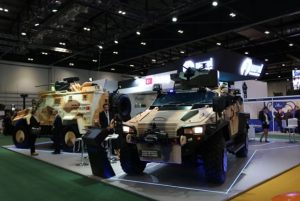
The age of drones is here, and it has changed the character of warfare.[ii] Yet their near-total dominance on the frontline is unlikely to last.[iii] Electronic Warfare (EW) systems, airburst munitions, Directed Energy Weapons (DEW), and advanced radar tracking are maturing and combining to effectively curb UAS omnipotence. US forces are fielding high-powered lasers for Counter-UAS (C-UAS),[iv] while the UK has trialled both high powered lasers and radio-frequency DEW systems that can disable swarms at a kilometre.[v] Drones will not disappear, but their role in a more contested aerial environment will become more deliberate and mission-specific, and exploiting weak-points and depth to achieve a more targeted effect.
Nevertheless, C-UAS protection will be uneven and gaps will remain, especially in depth. Convoys will have immediate C-UAS cover while transiting between defended “bubbles,” but the intervals between bubbles are exploitable. Moreover, drones adapted to emplace passive improvised explosive devices (IEDs) along Main Supply Routes (MSRs) will evade active C-UAS entirely. Ukraine already sees FPV drones set down along MSRs lying in wait and used for short-range ambushes, and Russia’s history of integrating mines and IEDs into hybrid warfare suggests such methods will certainly feature in its next conflict. Western forces must anticipate this evolution and equip accordingly.
The Case for a New Generation of Protected Mobility
If UAS has made every echelon vulnerable, then Protected Mobility (PM) is no longer a luxury but a requirement for force survival and strategic credibility. While frontline units may benefit from layered EW, C-UAS, and SHOrt-Range Air Defence (SHORAD) coverage, the majority of an Army’s people (i.e. Logistics, Medical, C2 staff) will operate in areas where such protection is patchy and node-based. It is the links between these nodes, the arteries of an army’s lifeblood, that have become the most exposed.
This new environment demands modern, agile and robust PM platforms able to sustain tempo, protect soldiers, and keep critical information and materiel flowing. This is a paradigm shift from earlier PM designs used notably in Iraq and Afghanistan which prioritised armour at the expense of manoeuvrability, trapping forces on tarmac roads and predictable movement corridors making them ideal IED targets. Lessons from Ukraine confirm that more mobile and better-balanced vehicles have proven more survivable because they can disperse off-road, exploit cover, and move at tempo. Today’s platforms must deliver both: survivability and freedom of movement – generating true Protected Manoeuvrability.
Protected Manoeuvrability: A Game-Changer
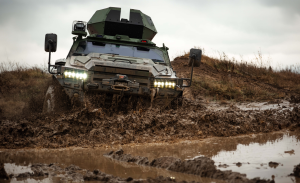
Enabled by advances in automotive technology and armour design, modern PM is no longer the trade-off between protection and movement seen in the early 2000s. Platforms such as the combat-proven NMS UK Dragon and Nomad combine STANAG 3-4 protection with terrain access once reserved for light unarmoured vehicles. This delivers Protected Manoeuvrability: the ability to disperse, exploit terrain, and avoid predictable channels while retaining survivability.
This is more than a technical adjustment, it is doctrinal; manoeuvrability becomes the key currency. Obsessing over incremental armour improvements at the expense of mobility results in tactical paralysis; true battlefield manoeuvrability offsets risk, reduces exposure, and restores initiative. In doctrinal terms, it bridges the gap between light forces that move freely but are vulnerable, and heavy forces that survive but cannot disperse. Protected Manoeuvrability offers the synergistic blend of the agility of the former with much of the survivability of the latter. Recent conflicts have repeatedly shown that units equipped with mobile, protected platforms able to exploit terrain survive longer, reach further forward, and retain better cohesion under fire.
Mass, Cost, and Industrial Reality
No discussion of modernisation can ignore cost. Ukraine has demonstrated that attrition of high-end platforms is inevitable in prolonged war. The destruction of both Russian and Ukrainian tanks and armoured vehicles by cheap loitering munitions underscores the futility of relying solely on exquisite systems. Mass, not just quality, remains decisive.[vi]
Yet procurement processes are geared to pursue exquisite, and thus expensive, platforms that lead to a reduced fleet size and thus resilience. A single high-end vehicle costing twice as much as a competitor may offer marginal performance gains, but its loss represents double the financial attrition. Smaller fleets also reduce flexibility: units cannot disperse or sustain losses without undermining their mission.
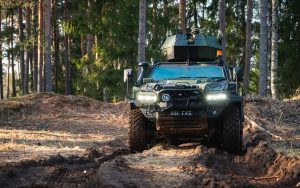
Smarter industrial partnerships offer a way forward. NMS UK’s modular engineering approach demonstrates how adaptable platforms can be delivered at lower cost, freeing resources for scale and for complementary capabilities like C-UAS. In a European land war scenario, where attrition rates will be high, numbers matter. Massed PM platforms providing survivability across echelons may prove as decisive as main battle tanks.
This is not only a budgetary point, but also a strategic one: Industrial capacity underpins mass. The ability to produce protected vehicles at scale, sustain them in theatre, and replace losses quickly will shape the outcome of prolonged conflict. NATO’s recent debates on stockpiles and production lines echo this reality, and experts reiterate that European defence industry should be incentivised to expand the capacity to build drive trains and armoured hulls.[vii] For the UK, balancing survivability, manoeuvrability, and affordability in PM procurement is therefore essential to credible deterrence; as well as recognising those who are investing in creating this necessary production capacity as a core part of the National Armaments ecosystem.
From Tactical Edge to Strategic Backbone
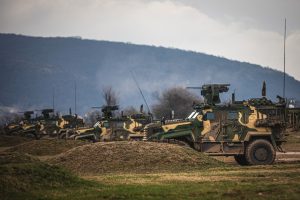
The evolution of the threat, from UAV swarms at the front to IED ambushes in depth, compels a redistribution of protection across the force; Protected Manoeuvrability provides that redistribution. It ensures mobility and survivability at scale, underwrites strategic endurance, and supports the Chief of the General Staff’s tiered force design of 40% consumable, 40% attritable, and 20% survivable.[viii]
The NMS Dragon’s decade of service, its evolution into the Nomad and Lurcher variants, and its adaptation into more than 20 roles illustrates what flexible PM can achieve. Such platforms can serve as the backbone of a modern, massed, and resilient land force.[ix] Built around this backbone, armies can future-proof themselves: designing vehicles for spiral innovation, with space for new sensors, counter-drone systems, electric propulsion and autonomy.
Protected Manoeuvrability is not simply about surviving the current drone dominated battlefield but about being ready for and shaping the next phase of warfare. As drones evolve into more autonomous, longer-ranged, and AI-enabled systems, mobility will remain the critical bulwark. Survivability must rest on the ability to move unpredictably, at scale and with sufficient protection to endure attrition.
Conclusion
The age of drones has already changed warfare; their saturation of the battlespace has expanded vulnerability across every echelon, forcing armies to rethink protection, mobility, and mass. But drones are only one part of a broader contest. The decisive factor will be whether Western forces can evolve their current limited protected mobility into Protected Manoeuvrability, through platform choices that are able to sustain manoeuvre, ensure survivability in depth, and maintain mass under attrition. All underpinned by the necessary industrial capacity, built at scale and pace ahead of the threat through a new generation of partnerships with dynamic and engaged defence industry actors, such as NMS UK, ready deliver cost-effective, sustainable, combat-proven, and innovative solutions.
Words: 1,431
[i] Small Wars Journal, “How Russia’s Hybrid Warfare Is Changing,” July 2023.
[ii] Kunertová, “Drones are Changing the Character of Warfare Itself,” Journal of Strategic Studies, 2023.
[iii] Reuters, “Ukraine, Taiwan Face-offs Help Drive Drone, AI Revolution,” December 2024.
[iv] US: RCCTO – DE-M SHORAD Project.
[v] UK: Dstl Team HERSA Project SWINTON and Project EALING.
[vi] RUSI, “Tactical Developments During the Third Year of the Russo–Ukrainian War,” February 2025.
[vii] RUSI, “Tactical Developments During the Third Year of the Russo–Ukrainian War,” February 2025.
[viii] RUSI Land Warfare Conference 2025: Chief of the General Staff keynote speech, June 2025.
[ix] Hungary Today, “Gidran Combat Vehicles Increase Operational Capabilities of Land Forces,” February 2023.