

The rapid evolution of unmanned aerial systems (UAS) and counter-unmanned aerial systems (C-UAS) constitutes one of the most significant developments in modern defense. What began as a peripheral concern has now become a defining characteristic of contemporary conflict. The interplay between offensive ingenuity and defensive adaptation guarantees that this technological competition will continue to evolve without foreseeable conclusion. Where it ultimately leads remains uncertain, yet one fact is beyond dispute: drones will remain integral to the battlespace, and counter-drone measures must advance in tandem. Just as automated technologies transform civilian life, the battlefield too offers a window into a contest of adaptation that shows no signs of slowing.

A useful framework for assessing progress in this field is the simplified process flow of Detect, Track, Identify, Decide, Act. Known in doctrinal parlance as the “kill chain,” this sequence provides a structured means of evaluating both technological innovation and operational challenges. Before exploring each stage, however, it is important to reflect upon the changes drones have imposed on traditional air defense capabilities.
A New Layer of Air Defense: The “Air-Ground Littoral”
Conventional air defense (AD) has long relied on layered systems, employing long-range interceptors, medium-range weapons, and short-range systems in a cohesive structure. While this layered principle remains central, the emergence of drones has necessitated the introduction of a new dimension: Layer 0. Sometimes described as a “green sky” or the “air-ground littoral,” this layer is dedicated to low, slow, and small aerial threats operating near the surface and within complex environments.

Layer 0 requires distinct techniques, tactics, and procedures (TTPs), supported by technologies and systems that effectively counter the threat. Unlike higher layers, it must contend with thousands of additional data points—ranging from drone signatures to swarm behaviors—and ensure their integration across multiple command levels. The result is a dramatic increase in complexity and urgency for system interoperability.
Moreover, drones have erased the concept of secure rear areas. Supply depots, command posts, and critical infrastructure, once insulated by geography, now lie within range of even low-cost drones. Operations such as Spiderweb and Rising Lion underscore this point, demonstrating how drones can infiltrate deep behind front lines, undermining both physical security and psychological assurance. Beyond their kinetic role, drones now serve as tools of psychological warfare, capable of targeting leadership, logistical disruption, and inducing cognitive strain across the force.
Detection Capabilities: Beyond Range
For years, the central question in C-UAS discussions was: How far can your radar detect a drone? Today, this metric alone is insufficient. Detection, absent actionable data, leads to operator fatigue and decision paralysis. The focus has shifted decisively towards actionable data at range.
Two developments illustrate this shift. The first is a conceptual change: Detection must provide immediate and actionable information, not merely a radar return. A contact must be tied to a system capable of informing higher systems and Command decisions.
The second is a technological evolution. The conflict in Ukraine demonstrates the competition between radio-controlled drones and electronic warfare defenses. This contest has accelerated the development of fiber-optic drones and autonomous flight, both of which are resistant to jamming and capable of dynamic rerouting. For defenders, this underscores the centrality of radar.
Yet radar itself is increasingly vulnerable. Adversary electronic intelligence (ELINT) systems excel at locating and targeting radar emissions. To counter this, militaries are deploying distributed radar systems: low-SWaP (size, weight, and power), commercial-off-the-shelf (COTS) radars spread widely across operational echelons. This creates a form of “security through obscurity,” presenting the adversary with too many emitters to effectively neutralize.
Emerging radar concepts also merit attention. “Cognitive radar,” which adapts waveforms and beam patterns dynamically based on external data, is now entering operational service. Once confined to high-cost systems, these features are increasingly available in commercial platforms such as Echodyne’s software-defined EchoShield radar, a notable example of advanced yet accessible capability.
Tracking: From Detection to Action
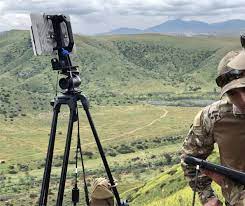
Detection alone does not enable engagement; without a track, no action is possible. Track fidelity is therefore decisive, and may be understood in four attributes:
- Accuracy and Precision: Angular and range accuracy must be sufficient to guide weapon systems. Range itself is less important than the ability to maintain accuracy at range.
- Comprehensive and Complete: Radar must create a holistic operational picture, sustaining accurate tracks on all relevant contacts.
- Consistent and Reliable: Intermittent or unreliable tracks erode operator confidence and increase mission risk.
- Data Speed: Traditional spinning radars may provide accuracy but often update too slowly to support rapid engagements against drones.
The optimal sensor is not only accurate, comprehensive, and reliable, but also mobile. Fixed systems are attractive targets, necessitating performance across fixed, portable, temporary, and on-the-move (OTM) modalities.
Identification: Intelligence at the Edge
Advances in artificial intelligence (AI) and machine learning (ML) are accelerating progress in identification. Edge-based AI can now classify drones more quickly and accurately, particularly when trained on extensive datasets using recursive neural networks (RNNs). Over time, this enhances radar’s ability to autonomously distinguish drones from other airborne objects, as well as to evolve from advanced classification to radar-based identification.
Nevertheless, data fusion remains the core challenge. While edge-based AI is promising, centralized architectures that combine data from multiple sensors continue to provide the most reliable outcomes. The future may lie in vehicle-level AI systems capable of integrating all available sensors and effectors into a unified decision-making process.
Decision-Making Under Pressure
Time is the most constrained variable in counter-drone operations. Drones compress decision cycles to seconds, challenging operators in ways unimaginable two decades ago. As UAS platforms grow faster, more agile, and more versatile, this pressure will only intensify.
Emerging threats such as swarms—multiple drones operating in coordination—demand new approaches. Swarms incorporate advanced sensors, deep data fusion, and AI that can either inform a human operator (human-in-the-loop, HITL) or act independently (human-on-the-loop, HOTL). Consequently, the counter-UAS sector is evolving towards greater autonomy, with machine intelligence increasingly indispensable to timely decisions.
Action: Shaping the Economic Exchange Rati
Upon identification, commanders face the decision of whether—and how—to act. While inaction remains an option, most platforms are designed for decisive overmatch. Adaptation of existing weapon systems is proving critical in this domain.
Remote Weapon Stations (RWS) exemplify this adaptation. With incremental modifications, RWS platforms are becoming effective anti-drone assets. Four innovations underpin this transformation:
- Meshed Networks and OTM Sensors: Networks of mobile radars ensure broad, continuous coverage and enable cooperative targeting in real time.
- Integration of Low-SWaP Radars: Systems such as Echodyne’s EchoGuard and EchoShield provide the precision tracking necessary for the fire control system to target enemy drones.
- Programmable Airburst Munitions (PABM): Developed by firms including Rheinmetall and Northrop Grumman, these munitions enable cannons of various calibers (e.g., 30x113mm, 30x173mm) to neutralize drones effectively.
- Directed Energy Weapons (DEW), such as high-energy lasers and high power microwave, represent a further development path. Companies including EOS (Australia), Blue Halo, Raytheon, Epirus, and others continue to advance such capabilities, which also rely on radar precision for effectiveness.
These innovations are recalibrating the economic exchange ratio of drone engagements. The strategic objective is cost parity—ensuring that inexpensive drones can be defeated without resorting to disproportionately costly interceptors.
Strategic Implications: Europe at the Forefront
The Russian war against Ukraine has highlighted the immediacy of the C-UAS challenge for Europe. Drones are no longer limited to ISR missions; they now serve offensive, defensive, and psychological purposes. Formerly safe rear areas are within reach of even improvised drone systems. For NATO planners and European defense industries, this reality compels a rapid reconsideration of doctrine and an accelerated pace of capability development.
Europe possesses significant advantages in addressing this challenge. A robust industrial base, advanced research ecosystems, and direct exposure to the conflict’s operational lessons position European nations at the forefront of innovation. Integration of commercial radar, artificial intelligence, and networked defensive architectures will likely define the next stage of C-UAS development.
Conclusion: The Drone Era Is Here to Stay
History demonstrates that warfare does not evolve linearly. Just as militaries consolidate doctrine, new technologies emerge to disrupt established practices. In recent years, drones have fulfilled precisely this disruptive role. From intelligence and surveillance to offensive strikes and swarm operations, drones have demonstrated their capacity to transform the battlefield.
Countering them demands more than new sensors, weapons, or algorithms. It requires an intellectual and doctrinal shift in how the battlespace is conceived. The contest between drone and counter-drone is not an aberration, but rather the foundation of a new epoch in warfare. For Europe, the imperative is unequivocal: adapt, innovate, and assume a leadership role in shaping the future battlespace.