

Commercial Off-The-Shelf (COTS) products are rapidly transforming how the military evaluates and introduces new technology and equipment. Once the preserve of bespoke, built-to-order specialised systems, procurement of military hardware now increasingly incorporates COTS components, enabling defence forces to tap into cutting-edge advancements at a fraction of the cost and development time.
Here, Tristan Wood, founder and CEO of world leaders in hybrid connectivity systems Livewire Digital, explores this rapidly evolving landscape.
This shift from the design and procurement of bespoke military equipment to COTS is driven by the rapid pace of technological innovation in the commercial sector, where advancements in AI, autonomous systems, and communication networks are breaking new ground daily. By integrating COTS solutions, armed forces can deploy the latest technology for tasks ranging from intelligence and surveillance to logistics, gaining immediate access to high-quality tools without waiting for traditional slower procurement cycles for direct deployment.
This approach is also revolutionising how military equipment is maintained, upgraded, and scaled. COTS systems are designed to be modular and easily adaptable, meaning they can be rapidly updated or reconfigured to meet evolving mission requirements. Additionally, COTS-based innovations like hybrid connectivity solutions and advanced communication networks are at the very cutting edge of change and technological innovation where things barely stand still for more than a handful of years, sometimes less. COTS has become a prerequisite therefore.
On the move

Defence technology is often a trailblazer for civil systems and applications, and innovation in voice and data communications is no exception. As national armies and alliances, innovate with technology to seize and hold the military advantage, the boundaries of possibility are constantly being pushed.
One thing which hasn’t changed is the cruciality of communicating-on-the-move (COTM). Whether on land, sea or in the air, COTM relies on the most robust connectivity solutions to enable rapid information exchange, situational awareness and ISR (Intelligence, Surveillance, and Reconnaissance) to allow for seamless command-and-control, and to ensure human safety.
People and machines
This has ushered in a new era of satellite communication on the move (SOTM), enabling secure messaging, voice and information exchange, including the emergence of the military internet of things, MIot, with much of the backbone to this technology already proven and being used in civil and commercial markets.
Today’s battlefield is not just about decisional information, it has extended to machines and sensors which talk to each other across a wide range of communication networks, from cellular to secure point-to-point systems.
Enter Heterogeneous or ‘true’ Hybrid connectivity
Already being used in first response markets in the UK, the solution lies in hybrid connectivity, deploying the resources of the full spectrum of communications infrastructure to avoid reliance on single points of failure and maximise available resources to ensure always-on, intelligent connectivity wherever and whenever it is needed. Hybrid can also sit at the heart of interoperability, between legacy and new technologies, to provide seamless communication between allied forces with different tactical military communication systems and infrastructure to maintain operational continuity.
The capacity for selective use of satellite networks, alongside the ability to combine this with the power of all other available networks, lies at the heart of hybrid connectivity and the many advantages it can offer. Unfortunately, however, hybrid has not yet made the inroads it should be making in the defence arena at the potential cost of human life and premium assets in contested battlespace.
Resilience not redundancy
A key benefit which hybrid connectivity brings to battlespace is its ability to bolster resilience to physical and cyber-attack. By combining resources across the full spectrum of available channels on a wide area network, (WAN) including satellite, hybrid connectivity mitigates against single-point failures and ensures continuity of operations even in the face of persistent interference and disruptions caused by adversaries.
At the core of hybrid is commercially available SD-WAN – a technology that uses software-defined networking concepts to distribute network traffic across the WAN. As a result, hybrid SD-WAN networking can agnostically combine and transition between these networks. Instead of relying on failover using classic routing techniques which replaces one bearer with another, hybrid SD-WAN bonds all available connections into a single, seamless and heterogenous ‘pipe’.
Applying this technique to connectivity on the move, where the availability and characteristics of networks change rapidly, a hybrid solution overcomes the challenges of intermittent connectivity, poor performance and resultant difficulty in scaling. Moreover, with hybrid, multiple network technologies are engineered to work seamlessly together and share the load and resources, performing according to any range of preconditions programmed into the underlying architecture.
In civilian settings, bonding and optimisation of communication paths within a hybrid network are enabling drones to deliver live low-latency video and advanced 3D world sensing & mapping data. This is already being deployed with great success in the policing and first responder situations, from the management of serious incidents involving multiple agencies to the provision of emergency telehealth, deploying remote diagnostics and supervisory support from hospital-based doctors and other specialists right down to the roadside.
The UK Defence Drone Strategy
As outlined recently by James Cartlidge in UK Defence Drone Strategy, the return of war to Europe has underlined the essential requirement for a ‘resilient, robust and agile approach to defence procurement’. The conflict in Ukraine has vividly demonstrated a ‘new era of warfare,’ marked by rapid innovation, the widespread adoption of technology, battlefield digitisation, and an urgent need to build capabilities that match the fast pace of operations. COTS must therefore be deployed more widely if we are to capture and harness innovation to provide military advantage.
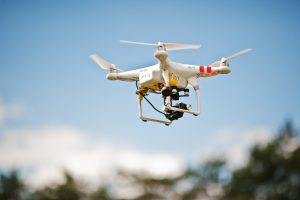
Nowhere is the battlefield digitisation shift more evident than in the rise of uncrewed aerial systems (UAS), affordable, agile solutions that are successfully countering more sophisticated threats and delivering noticeable impacts on the battlefield.
Conventional UAS that use licensed and regulated cellular communications will use either LTE/4G, which uses a range of frequencies below 6 GHz, or 5G connectivity, which offers connection speeds that are hundreds of times faster still and is ideally suited for resource-heavy operations such as real-time HD footage during autonomous deployment.
Meanwhile, satellite technology, with high uptime and reliability, can offer global always-on communication and control. Historically, satellite technology has been expensive to integrate and generally been deployed on large, high endurance and military UAVs flying over large distances and at high altitude. Few commercial deployments have been able to justify the capital and operational costs, the power budget and equipment weight associated with satellite connectivity, especially when they may be operating at low elevations where line of sight to satellite may be compromised.
However, despite recent advances in telecommunications technology – from 5G and disruptive low-cost LEO satellite services – no single network service can address the exponential demand for seamless connectivity on the move. Nor is there any provider which can offer a single comprehensive solution that can address coverage, bandwidth, reliability and most importantly cost.
The concept of a drone – fitted for example with a world-first COTS solution like RazorLink, which Inmarsat, now Viasat has embedded within its newly launched maritime-focused NexusWave – agnostically making use of any carrier network, based on location, cost or quality of service, has too long been a guarded secret. But it shouldn’t be. And in UAS and many other sectors, the market opportunities are seemingly unlimited for the adoption of true hybrid.
As well as their destructive power, UAS as airborne observation platforms significantly enhance situational awareness and the creation of a common operating theatre view. They can also be a crucial aid by acting as a relay point, connecting tactical units with the command post. With hybrid connectivity, drones or other assets can move seamlessly between networks, picking and choosing bearers of opportunity based on any range of preset criteria.
Reshaping the future
There are plenty of use cases where military drones will play a crucial role in the future, including swarms of drones and other distributed systems. However, their capabilities will only be fully realised with the robust connectivity that true hybrid alone can guarantee.
Whether for UAS connectivity, MIoT or providing the most resilient command, control, and communications (C3) networks in battlespace, the integration of Commercial Off-The-Shelf (COTS) technology and hybrid connectivity solutions is available to reshape military capabilities, rapidly delivering agile, cost-effective, and advanced technologies to the frontlines. By adopting COTS solutions more widely than at present, the military can keep pace with the digital revolution unveiling itself at breakneck speed and in the process ensure we stay one step ahead in a rapidly shifting landscape.
Tristan Wood
As Managing Director, Tristan has positioned Livewire as the leader in hybrid connectivity, developing resilient network solutions for future connectivity needs. Tristan has extensive expertise in mobile, fixed, and satellite communication technologies, overseeing projects from industrial control systems to advanced R&D for major telecommunications companies.
His technical background in real-time systems, video technologies, communication protocols, and software engineering allows him to effectively manage product architecture and delivery. Tristan combines strategic foresight with hands-on technical leadership, ensuring innovations align with market needs and client objectives. His ability to anticipate industry trends and adapt strategies has been crucial to Livewire Digital’s success and competitiveness.