

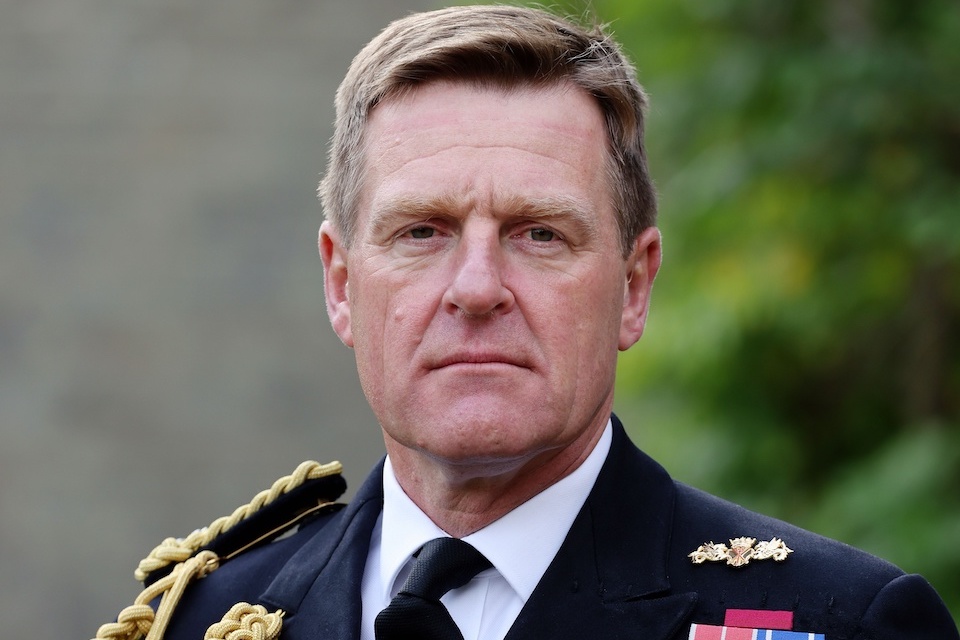
First Sea Lord, Admiral Sir Ben Key, delivered his keynote speech at Defence and Security Equipment International (DSEI) 2023.
Ladies and Gentleman, good afternoon. I’m delighted to be back at DSEI and ExCeL, with so many friends and colleagues from defence and industry, both national and international.
This week I sense “pace of change” is a phrase that will be repeated often from this podium and others, together with superlative adjectives like “unprecedented” or “relentless”.
Because where once the next change meant waiting a generation, we are now seeing several iterations of change within a generation.
And as the world changes so we find ourselves in a race to stay ahead. It’s not only an academic or technical argument, it is very real, very current and the only outcome can be winning.
There is no room for second place, and as General Sir Jim Hockenhull described yesterday, rules and conventions won’t protect us either.
Now, in the first frigate I commanded in 2000, which is berthed just outside here, computers with less processing power than a smart phone took up entire rooms and ran only parts of the ship. Today, our most modern ships are digital with a beating heart of silicon, so embracing change is a natural part of our DNA.
Whether in sail, to coal, to oil, to high voltage electrical propulsion, or in cannon, to rifled guns, to missiles, or canvas covered floatplanes, to jet engines, to uncrewed air systems, across our many centuries of history, we have anticipated, adapted to that relentless pace of change and always striven to be at its vanguard.
Like our forebears who struck out into the unknown to chart the world’s oceans, it feels to me that we are once again facing something completely new – a paradigm shift, dare I say it, a Dreadnought moment.
And that future is arriving now. It is with us, uncrewed, automated, it is digital, it is intelligent, blended, hybrid. It offers to fundamentally reshape the way the Royal Navy goes about securing our trade, energy and data for the nation.
And it comes at a time when the world we live in is changing too. The geopolitical challenge and technological race unfolding in Europe and in the Indo-Asia pacific is unlike anything in memory. Now more than ever is the time for strong deterrence and defence.
The Royal Navy has a history of doing this for centuries and our core missions are no different today, to protect our island nation and to help it prosper by deterring and, if necessary, defeating our adversaries whilst projecting national influence and power globally alongside our allies and partners.
But if we’re to maintain that mission, we must continue to accelerate the evolution that has been one of the hallmarks of our history. It is why we are undertaking a huge capital procurement programme, growing the Navy for the first time since the end of the Second World War with 16 ships and six submarines on order or in build.
And they will be in large part, if not entirely, platforms oriented around a digital framework, allowing a fundamental shift in the way we crew and operate them.
And in recognising the need to continue to develop the technology that is the heart of all we are doing, we have established teams to focus on innovation, explore quantum technologies to understand edge computing and trial what AI may mean for us.
In her first 12 months, XV Patrick Blackett, our dedicated trials platform has tested equipment such as a quantum accelerometer and future radars. This week she is in Portugal at REPMUS, an international exercise testing and integrating the next generation of autonomous systems alongside our allies and partners.
In CETUS, we are developing the largest and most complex crewless submersible ever operated by a European Navy and we have deployed to the Gulf our uncrewed minesweeping capability, fielding some seriously novel technology to counter the rapidly evolving threat of sea mines.
And just last week, we flew an uncrewed and autopiloted fixed-wing aircraft to and from HMS Prince of Wales at sea off Cornwall, in a first for the Royal Navy.
When Nelson sent his iconic ‘England expects…’ message at Trafalgar it required 32 flags for 9 words. Today, communication is as vital as ever but the volume and complexity of data, the extent of the messages we are trying to send, and the methods we have available to us would be incomprehensible almost just a generation ago, let alone in Nelson’s age. We will only be able to exploit and capitalise on this by becoming fully digital, and operating a Navy fit for the information age.
This means being able to collect, analyse and fuse data about the operational theatre and battlespace, to generate genuine multi-domain, multi-dimensional situational awareness. It means being able to do it at the front line, and being able to do it on time.
This year we are partnering with Microsoft to deliver Storm Cloud 2.0, a research and development project which is building a prototype edge-compute platform. And we will use it over the next 12 months to accelerate our digitisation of the maritime battlespace by charting a viable course to exploit edge cloud in the deployed environment.
And it is designed to be ‘AI-ready’. AI has exploded into common consciousness this year and is likely to reimagine our approach to warfare, creating dynamic new benchmarks for accuracy, efficiency and lethality. So in it, we are deliberately being ambitious, because we have to be. Falling behind risks being left behind.
So, we are committed to understanding what it means for us to become an ‘AI ready’ organisation, enabled to achieve consistent military advantage and effective deterrence.
It’s going to be hard work, and our success will fundamentally depend on our ability to integrate AI into all aspects of our capabilities – from the tip of the spear to our background business.
But AI is not the answer to it all, our environment is too complex for that. On the Royal Navy stand in Hall 5 you will find a focus on our Future Air Defence Dominance System, or ‘FADS’. The replacement to our Type 45 Destroyer, but so much more than just about ships. A system of systems designed to be completely dominant. Dominant in air defence, dominant in long range precision strike, blending existing ships and aircraft with cutting edge sensors, weapons, digital enablement, to ensure that we can do what we need to do faster, quicker, more, more lethally, and more accurate than those who would oppose us.
And through all of this, the common theme has to be our people. And so we want to become the employer of choice for school leavers that wish to develop and then use their digital skills.
And hence we are undertaking perhaps the most significant review of our workforce in a century. It is designed to ensure that we can compete to attract the best and brightest talent to the Royal Navy and provide the sort of career the next generation seek to have. Zig-zag in shape, lean-crewing, different remuneration, incentivisation packages, maximising our operational effectiveness. Inclusive, modern, forward-facing and diverse.
And they expect us also not just to embrace these opportunities, but to fulfil our obligations as members of the planet on which we live. If we do not adapt and mitigate our climate impact, they will not stay with us. We will face physical and human risks to our assets, transitional risks to our Operational Capability, and our people will leave.
So our approach has to be broad and sustainably-focussed, understanding how climate change will shape future operations, and for us to understand how we must shape ourselves for the operating environment we would wish our planet to be.
Lower emission fuels are certain to be part of this, and we do not underestimate the challenge around their use in the maritime environment. They offer real opportunity but are so novel that global production and availability are key limiting factors.
To ensure we are ready, and to drive development, we are planning with industry partners to conduct a shipboard demonstration of sustainable fuel. This is something we seek to develop alongside our allies too, as a multinational endeavour; like so many of the challenges we face today, this is one we must seek to overcome collectively.
The Royal Navy is a service with a long and proud history and tradition. But it is not shackled by it. For a good deal of that history, the Admiralty cohered and led our national maritime sector, achieving collectively more than the sum of its parts. Today our interest in the whole maritime domain remains as keen as ever, for those working across the sector from business to industry, government and the third sector, and around the world.
All of us engaged in the maritime domain understand the importance of the sea for trade and economic prosperity and it is reflected in the national investment underway, from shipbuilding to freeports.
I recognise, and sense that others do too, that as an enterprise we have to take the opportunity to advocate more strongly for our sector, essential as it is for our prosperity, our way of life, and our place in this rapidly changing world.
It is ever more connected, we are bringing to bear the deep tissue of connectivity we have, right across maritime business, industry, shipbuilding, charity, science, technology and academia. engaging across the length and breadth of this island nation – and with our allies and partners, both to explain what we’re about, to describe the obligations we need to meet, and to be sure that people can be confident in what we do, as part of our part of this great island nation.
I am confident we are playing our part in charting what tomorrow’s maritime world will look like, ensuring that the technological and environmental journey we are on is coherent with the work being done across the sector.
In the first speech I gave as First Sea Lord last Spring, I issued a call to arms to you, our industrial partners to work with us in the delivery and evolution of our service through the next decade and beyond.
Thank you for the way you have responded and the foundations being laid but there is no room for complacency. Every day counts. We are not setting the pace, our adversaries are doing that, we just need to work out how to move faster, more athletically, more fitter than they are.
And in doing do we will deliver a truly transformed Navy, one able to operate in the digital age, but more importantly, to fulfil the role we must play in protecting our island nation and helping it prosper.
Thank you.