

Ophir Optics is aware that the rapid proliferation of drones in recent years has introduced significant security challenges for both military and civilian entities, hastening the development of Counter-Unmanned Aerial Systems (C-UAS) technologies designed to detect, identify, and neutralize such threats.
Among the key technologies employed in C-UAS platforms, infrared (IR) imaging plays a pivotal role in enabling the detection, identification, and tracking of small unmanned aerial systems (sUAS).
Ophir, as a leader in precision optics, has developed state-of-the-art long-range IR continuous zoom lenses tailored for integration into advanced C-UAS platforms, offering superior identification and targeting capabilities.
Challenges in Countering UAS Threats
Unmanned Aerial Vehicles (UAVs), commonly known as drones, come in diverse configurations, sizes, and payload capacities, each with varying capabilities in stealth, altitude, and speed.
The wide range of these capabilities presents significant challenges for C-UAS platforms, which must accurately identify and target these UAVs across varying distances. Effective identification relies on obtaining highly precise visual data, which can be interpreted by operators or sophisticated Artificial Intelligence (AI) algorithms within the C-UAS systems.
Small UAVs pose a particular challenge due to their minimal visibility, even at close ranges. Conversely, larger UAVs, which can fly higher and carry more substantial payloads, are equally challenging to detect visually.
Infrared cameras, guided by C-UAS radar systems, provide critical information for identifying UAVs and assessing their threat level. These threats can range from surveillance activities to potentially lethal attacks involving missiles, bombs, or Weapons of Mass Destruction (WMDs), including biological, chemical, or radiological agents.
C-UAS platforms employ various methods to neutralize UAVs, including radio jamming to disrupt communication between the UAV and its base station, GNSS jamming to disorient the UAV, and spoofing to seize control by overpowering the original base station signal.
Some platforms also use kinetic means, such as missiles or net deployment, to destroy UAVs. In all scenarios, precise targeting hinges on accurate identification, a task where Ophir lenses excel, providing unmatched long-range identification capabilities day or night.
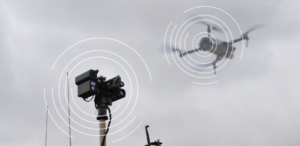
Technical Specifications for C-UAS Lens Systems
The primary objective of any electro-optical (EO) or infrared (IR) imaging system is to deliver sufficient, focused pixels on the target. According to Sandia National Laboratories, an operator requires at least eight pixels on target to accurately assess a UAV threat. Achieving this necessitates that the imaging system meets specific technical criteria:
- Field of View (FOV) and Focal Length: C-UAS systems demand lenses with multiple fields of view, best achieved through continuous zoom lenses. Lenses that enable AI-driven optimization of the FOV for varying scenarios are critical for faster system responses, reducing the need for operator intervention. Proper FOV ensures the imaging system captures the requisite pixels per meter (PPM) at a given range, measured using the instantaneous FOV (iFOV).
- Focus: Maintaining sharp focus during FOV adjustments and retaining focus on rapidly maneuvering objects is essential for optimized tracking and threat identification.
- Image Quality: High image clarity across the entire FOV and throughout the zoom range is crucial for tracking UAVs and identifying potential threats.
- Interface: Seamless mechanical and electronic interfacing with sensors and control systems is vital for integrating the lens into a C-UAS infrared sensor.
Ophir Lens Solutions for C-UAS Applications
Ophir Optics is globally recognized for its expertise in optics design and manufacturing. Beyond offering off-the-shelf products, Ophir collaborates with system integrators to develop customized lens solutions for a range of applications, including C-UAS. Two of Ophir’s premier solutions, the SupIR® 60–1200mm f/4 and the SupIR® 80—1200mm f/5.5, are ideally suited for long-range identification in C-UAS systems:
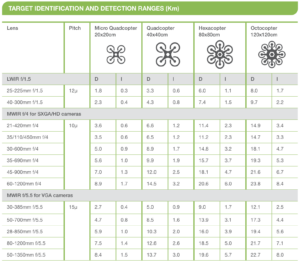
- Field of View and Focal Length: The SupIR 60–1200mm f/4 lens provides a narrow FOV capable of identifying a small quadcopter at over 3 kilometers, making it ideal for MWIR 10µm SXGA sensors. The SupIR® 80–1200mm f/5.5 lens, designed for MWIR 15µm VGA sensors, can identify the same quadcopter at more than 2.5 kilometers. These lenses offer system integrators the flexibility to customize C-UAS platforms for specific operational needs, ensuring rapid response to threats.
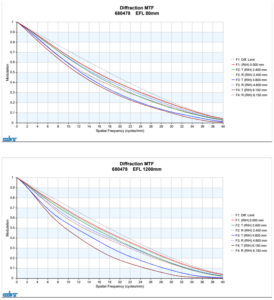
- Focus and Image Quality: All Ophir lenses retain focus throughout the zoom process, maintaining acquisition lock on targets and enhancing UAV threat identification. They also preserve line-of-sight (LOS) during zoom. Ophir’s lenses are renowned for their superior off-axis clarity and exceptional imagery throughout the zoom range, eliminating issues like narcissus and vignetting that could impede AI-based threat identification.
- Interface: Ophir lenses are equipped with OphirSIM software, facilitating smooth integration and communication between the lens and the C-UAS system.
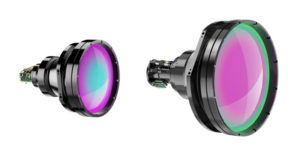
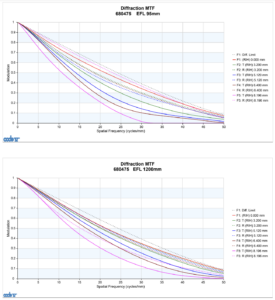
Optimized Solutions for Diverse C-UAS Needs
Ophir offers a wide range of long-range IR continuous zoom lenses suitable for various C-UAS applications. Depending on the specific scenario, such as drone size, altitude, and distance, the appropriate lens can be selected to meet mission requirements. Ophir’s extensive portfolio ensures that integrators can choose the optimal lens for any C-UAS deployment.
The rise of UAVs and drones has introduced significant threats in modern battlefields and critical infrastructure. While these threats often target non-military assets, they can be effectively countered using advanced C-UAS systems designed to mitigate swarm attacks from micro and mini-drones.
Thermal imaging systems, particularly those employing Ophir’s high-quality long-range IR lenses, play a crucial role in these defenses. Ophir’s lenses provide the precision and clarity necessary for successful integration into C-UAS applications, ensuring rapid and accurate threat identification and neutralization.
Visit the Ophir website to find out more.
(Source: https://www.defenseadvancement.com/)