

The defence environment is undoubtedly unique. Defence users often have to move at a moment’s notice, setup equipment in record time and often in very challenging conditions, whether that is extremes of weather, unforgiving terrain, or enemy fire. Of course, all satcoms equipment has to be resilient enough to work in extremes of temperature, but sometimes weather can have a huge impact on the functionality and connectivity, especially for high throughput satellite, which although offer highspeed connectivity and high bitrates, are more susceptible to weather. In the commercial world (first responder excepted), they have it comparatively easy as it’s much easier to at least predict weather outages and make provisions such as moving to another teleport before an outage.

However, in defence scenarios the equipment simply has to work no matter where it is being operated, it is not an option to move in many cases. It can be very difficult to predict weather in advance, as often operations take place at a moment’s notice. Even comms-on-the-move applications, while not as easy to move, in commercial use cases will likely have more time to plan and address any potential impacts.
Add to that the fact that defence operates in a mission-critical environment. For mission critical users such as government and defence forces and NGOs, communications are absolutely essential. Comms mean lifelines. They are the medium for information sharing and decision making and if they go down, the entire chain of command collapses. That’s why the equipment that is deployed to these areas must be optimised for any eventuality, making this a critical part of the design process. If a piece of equipment, whether it is an antenna, a transceiver or even the mount on which the antenna is on, is not able to withstand the conditions, it will be much more likely to fail. A chain, after all, is only as strong as its weakest link.
So, what are the considerations when designing satcoms equipment for defence? And how do manufacturers address these unique challenges?
Knowing Where You Are
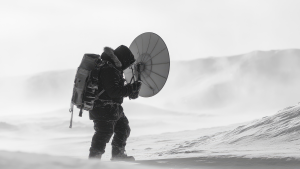
By far one of the biggest challenges in military environments is knowing your exact location. This may seem obvious, but you need to know exactly where you are so that you know where to point to be able to reach the satellite. This is especially vital as spectrum is heavily congested with more and more services relying on satellite, as well as being highly contested. This means there is no room for error, it is important to get the right satellite every time, to avoid both interference and disputes. It is easy enough for troops on the ground to work out which direction is North by using celestial bodies, such as the sun or specific stars even, however knowing your precise location can prove more challenging without the right tools. This is particularly vital for auto-deploy equipment as the operator needs to be able to input the location so the satellite terminal can point to the correct satellite and ensure seamless connectivity.
This is where a good position, navigation, and timing solution is absolutely vital. Without that, defence forces will need to spend their time with a map and working out coordinates to laboriously type into the terminal before it can be properly operated. This not only takes valuable time that troops can seldom spare, it also introduces the likelihood of human error. For this type of application, GPS is often compromised and not usable. Interestingly, the recent news from Iridium promises to be a complete game changer in this sector. It is rolling out a dedicated chip which means PNT capabilities can be integrated into existing electronic devices to provide accurate location and timing when in a contested or congested environment. It uses the Iridium satellite network to receive extremely accurate and secure time and location information. It also means forces can integrate it into their existing kit that they are anyway carrying, reducing the amount of kit they need to carry.
The Impact of WeatherWind, rain, blistering heat, freezing temperatures, or ceaseless crashing waves – when operating in extreme environments, communications equipment is subjected to a plethora of weather events, temperature extremes, environmental conditions, motion and vibration amongst other factors. Whether it’s on land, at sea, or in the air communication can’t always wait for better conditions. Satcoms equipment can be particularly susceptible to extremes of weather. Yet any equipment designed for these scenarios needs to be weather resistant, strong enough to withstand any number of potential knocks, and lightweight to carry over long distances.
So, how do we ensure at satcoms equipment can withstand these extremes? Partly it comes down to the right materials. Most ground equipment uses lightweight, robust material such as carbon fibre.
Of course, one other consideration for defence applications in particular is the heat signature given off by the antennas, making them easy to spot and target. Defence forces use various techniques to cover and hide the antennas, but this needs to be done in such a way that doesn’t impact their function – you can’t simply cover an antenna and expect it to work!
Many terminal components, such as waveguide, feed networks, are subject to things getting into the inner workings. This could be dirt, rain, ice, snow, for example, and all of those things will degrade their use overtime. The easiest way to address this is to have more parts that are sealed where feasible. Of course, this makes it harder to swap out individual parts within a sealed unit, but it makes those components much more resilient and able to operate in a variety of environments.
Strength, Durability, and Portability
Ensuring strength, durability, and portability of satcoms equipment, all essential properties in defence, mainly comes down to the choice of materials. Of course, satcoms equipment, whether used for defence or commercial needs to be a good conductor, be able to ensure RF performance, and withstand corrosion. In defence scenarios, there are even more pressures on the equipment, and therefore on the materials being used. With kit carried long distances over rugged terrain, having strong, robust materials is an absolute must. Of course, this also means that these materials need to be lightweight at the same time.
Many of the ground segment solutions will be constructed using strong and lightweight materials, such as aluminium and carbon fibre, with titanium used for those areas that need to be particularly strong.
Build it, Switch it on, Walk Away, It’s Going to Work
As an Army Colonel once put it to me, any equipment used in defence needs to be able to be put together by untrained personnel with no instructions. Anyone across the team could be called upon to get the equipment setup. Often, they need to do this with very little time and a lot of pressure. If you have something akin to an IKEA instruction booklet with numbered parts and stages, it simply will not be feasible. For milsatcoms equipment, everything needs to be fully interchangeable, so it can be put together in any order, by anyone, with no instructions, no tools, and nothing complex at all. A reflector could, for example, be made up of eight different parts, but they all need to be interchangeable.
Add to this the fact that often the equipment is being setup and deployed in particularly challenging conditions. The operator may be wearing thick arctic gloves that cannot be removed without risking frostbite, or they may be in full waterproof gear in the midst of a torrential downpour. In the case of marines, they could even be setting it up in challenging conditions at sea. And yet the kit still needs to be setup with ease in all of these scenarios.
Like I always say, defence users in particular need to be able to simply plug it in, walk away, and know the tech will just work!