


China’s long-term challenge will not be met with submarines alone.
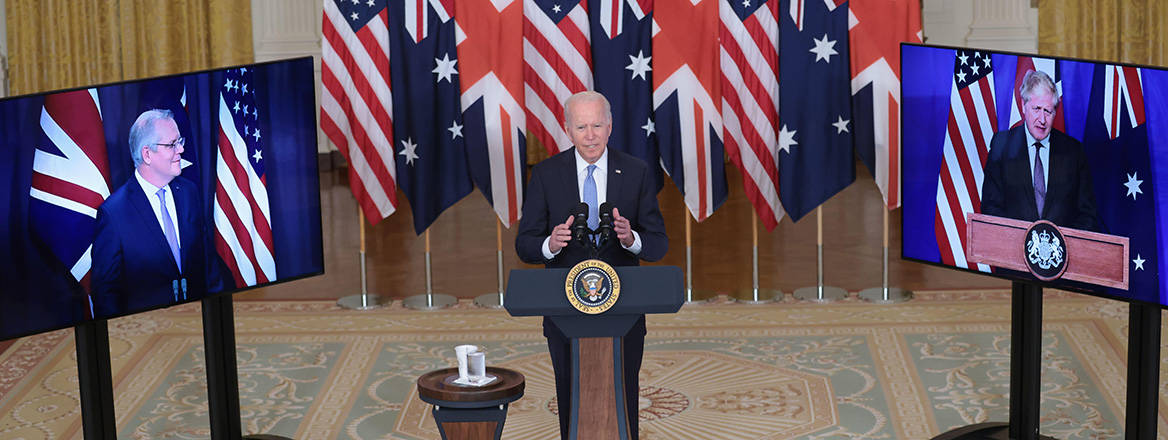
The announcement heralding the new Australia–United Kingdom–United States (AUKUS) partnership has rightly generated enormous fanfare and more than a little controversy. Its centrepiece alone – the delivery of nuclear-powered attack submarines to Australia – highlights the volatility of the Indo-Pacific security environment and the diplomatic, financial and technological risks the AUKUS capitals are prepared to take to address it.
It is a big deal, no doubt. But much of the hype needs to be put into perspective, especially for understanding the implications for the junior partner in this deal, Australia. Three points of perspective are in order.
First, as important as the submarine deal is, it is just one step – albeit a very big one – in a longstanding effort to significantly deepen US–Australia defence ties in the face of China’s growing power. Writing in Foreign Affairs in 2015, Tom Switzer and I described the emergence of a ‘new special relationship’ between Canberra and Washington, particularly in political, military and security affairs.
That relationship has only deepened since. In partnership with the US, Australia has committed substantial new resources to its defence. By 2019 Australia became the world’s second-largest arms importer (behind Saudi Arabia), driven in large part by acquisitions of US weaponry, including 72 F-35 Joint Strike Fighters, EA-18G Growler electronic warfare aircraft, E-7A Wedgetail airborne early warning and control aircraft, C-27J battlefield airlift aircraft, and MH-60R Seahawk antisurface and antisubmarine helicopters.
Add the newly announced deal, and Australia’s commitment to its military-technical relationship with the US only deepens further. The basic cost of building current US Virginia- and UK Astute-class nuclear attack submarines hovers around US$2.5 billion a piece, a figure which would not include the costs of reconfiguring the Adelaide shipyards in preparation for the build or the long-term expenditures for the deployment, sustainment and maintenance of the boats over their life cycle, all of which will carry a price tag in the hundreds of billions of US dollars spread across several decades. Moreover, because the US (and/or UK) nuclear propulsion technologies and systems will likely be ‘black-boxed’ – installed in the new boats, but not granting Australia an independent capability to build them itself – Australia will remain deeply dependent on its partners for the continuing operation of these strategic assets for decades to come.
In addition, Canberra recently announced its intention to prioritise advanced, long-range, precision-strike missiles, especially anti-ship missiles, and including hypersonic missiles. This is part of a major new procurement programme developed in cooperation with US defence contractors and expected to cost tens of billions of US dollars over the course of the 2020s and beyond. And there is much more to come. Coinciding with the AUKUS announcement, the annual Australia–US Ministerial talks signalled the intention to expand the rotational presence of US aircraft, surface vessels, submarines and military personnel in Australia. The two sides also plan to augment Australia’s role in providing maintenance, repair and overhaul of US forward-deployed weaponry and increase the pre-positioning of US munitions and other materiel on Australian soil.
It is therefore important to see the AUKUS announcement in the context of this extensive and ongoing Australia–US defence partnership. In doing so, the submarine deal becomes somewhat less surprising – notwithstanding the understandable anger in France about the collapse of its joint submarine programme with Australia and the blow this has dealt to US, UK and Australian relations with their French ally.
Second, we need to assess the submarine deal in relation to the problem it is trying to address: China’s rapidly growing military capabilities, particularly in the maritime sphere. According to the US Department of Defense, China already has the world’s largest navy and the world’s largest shipbuilding industry by tonnage produced. Importantly, in comparison to Australia, China also produces virtually all of its naval weapons and electronics, making it almost entirely self-reliant in the development and deployment of sea power. The People’s Liberation Army Navy has a fleet of over 350 ships and submarines, a number which includes 130 major surface combatants and over 60 submarines. Of the subs, 10 are nuclear-powered – six attack submarines and four ballistic missile submarines, the latter designed to carry nuclear weapons. More nuclear-powered and conventionally powered submarines are in the pipeline. In other words, even if the Australian navy ultimately deploys eight new nuclear submarines by the end of the 2030s – a very big if – they will still be greatly outnumbered by the Chinese fleet. In short, the new nuclear-powered subs will eventually be a powerful addition to Australia’s arsenal, but in and of themselves they will not be a game-changer in the face of China’s massive naval capabilities.
Finally, we need a sober-minded perspective about the challenges still ahead for the proposed submarine plan. This will mark the third time since the 1990s that Australia has joined a foreign partner to produce submarines. Numerous problems plagued the construction of Australia’s current fleet of Collins-class diesel electric submarines as well as the initial stages of the now-defunct Australia–France submarine programme. These issues demand reflection on how such setbacks can be avoided this time around. This will be one of the biggest and most complex technological undertakings ever attempted in Australia, with innumerable difficulties large and small. Recently constructed Virginia-class submarines in the US take about three years from lay-down to commissioning, and that is with some 20 years’ experience in building these boats. We should expect similarly long production timelines for the Australian programme. Even if all the preliminary negotiations and industrial preparation go smoothly – which is unlikely – we should not expect the first of these new submarines to enter service until the late 2020s or early 2030s. In the meantime, Australia will continue operating its six Collins-class submarines which were slated for decommissioning, but which now require refurbishment to extend their operations past their planned ‘use by’ date.
These balancing perspectives are both comforting and concerning. On the one hand, the AUKUS-driven delivery of new submarines highlights an already robust Australia–US defence relationship and further cements the UK’s commitment to that partnership. But on the other hand, China’s burgeoning coercive, deterrent and warfighting capabilities can only be expected to grow apace. AUKUS, to realise its fullest potential, will need to deliver well beyond its current flagship initiative.
The views expressed in this Commentary are the author’s, and do not represent those of RUSI or any other institution.