


In an interview with Arun Arumugam, the APS Business Development Director gave BATTLESPACE Editor Julian Nettlefold an overview at Eurosatory 2024 about the SKYctrl system including the SKYctrl command and control (C2) CyView tool and other APS products and systems.
“Could you give our readers an outline of the SKYctrl system?” the Editor asked.
“SKYctrl is a battle-proven comprehensive counter-drone solution that is based on military-grade radar technology powered by APS’s FIELDctrl 3D MIMO radars, a soft-kill jammer and APS’s very own command and control (C2) CyView software tool. The system provides accurate detection and tracking of multiple aerial targets at once, differentiation them between birds and drones, and reports the target’s exact 3D position in real-time. APS’s soft-kill jammer allows for effective neutralization of hostile targets by jamming over 20 bands including, ISM, VHF, UHF, GSM, UMTS, LTE, GNSS and WiFi. SKYctrl can also be integrated with hard-kill effectors.” Arun Arumugam said.
“Tell us more about the benefits of the command and control (C2) CyView tool?”
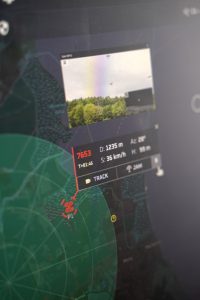
“SKYctrl’s (C2) CyView is a highly valuable utility for understanding the VSHORAD air picture many Armed Forces. With this, we can monitor and track accurately any kind of movement in the airspace and confidently know if it the target is a bird or a drone. We have developed the software to provide users with the most effective comprehensive anti-drone system there is in the market today. The interface is intuitive to the user which makes it highly effective and easy to operate. It can also be integrated to present data from a host of other CUAS sensors (e.g., RF and EOIR systems).”
“The SKYctrl Prediction Tool (PDQ) analyses the complexity of the environment when the radars are first deployed to enable the end user to determine the most optimum set-up of the radars to attain maximum protection of the airspace” Arun Arumugam explained.
“Can SKYctrl differentiate between birds and a UAS Swarm?”
“Yes, that is our key differentiator. SKYctrl’s software is able to instantly classify detected aerial targets as either birds or drones. Using our proprietary algorithms, SKYctrl presents accurately to the user the flight track of the detected target, the direction, distance, altitude and speed . When a flock of birds suddenly mixes with a swarm of drones, we will immediately distinguish them and provide a fully-clear view of the airspace. Advanced neural network algorithms will track selected objects in real-time, register all incidents, and learn on their own how to protect the selected area in the best possible way.”
“Can C2 CyView integrate with other systems?”
“Yes, C2 CyView has a customizable and friendly interface and it can be used to support stationary and mobile deployment configurations of SKYctrl. There is also an open API for integration with external systems.”
Radar Types
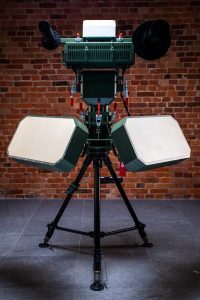
The company has four different types of radars, generically known as FIELDctrl 3D MIMO Radars. These are Advance, Runway, Range and Ultra – the latter being the latest radar offering an effective detection range of 6km for Micro-UAVs with a radar cross-section (RCS) of 0.01sqm. The radars are modular and fully-configurable sensors using 3D MIMO technology for advanced performance. These FIELDctrl radars can be deployed in stationary, portable and mobile (vehicle mounted) configurations.
Military Integration
APS radars have been integrated on the MSI-DS TERRAHAWK PALADIN, a self-contained, comprehensive CUAS solution developed for augmented mobility and deployability in close range air defence. The system is equipped with a range of sensors and a hard-kill effector. It can be transported on a military support vehicle (or trailer-based system) with the requisite space and payload capacity, such as the NATO-standard Demountable Rack Offload and Pickup System (D.R.O.P.S.). The MSI-DS TERRAHAWK PALADIN can be deployed on the ground with offset remote control for operator survivability (hard-wire or Line of Sight). The integration of APS’s FIELDctrl radars and (C2) CyView system is performed by MSI-DS. The system is equipped with the 30mm MK44 Bushmaster chain gun, which provides the assurance of class-leading accuracy, lethality, and survivability.
The MSI-DS TERRAHAWK PALADIN system has been sold to a number of overseas customers and it can be deployed as a singleton for point defence roles, or as part of a network under a Combat Management System (CMS) for wide area defence. This enables the MSI-DS TERRAHAWK PALADIN to capably fulfil a wide range of field roles such as protecting high value targets, critical infrastructure, vulnerable points, as well as acting as a force multiplier for coastal and border protection.
Integrated Air Defence Systems
“Does APS produce an integrated air defence system?”
“Absolutely, SKYctrl is integrated with modern air defence systems and it performs a critical function in the VSHORAD air defence layer. Our FIELDctrl radars perform flawlessly in the most demanding battlefield conditions.”
“How many customers use SKYctrl?”
“This system is being used in over 22 countries across the globe including the Polish Armed Forces. One of the key reasons SKYctrl was chosen by the Polish Armed Forces is because of the accuracy of our radars in tracking the target and it’s unique ability to instantly classify the target.”
“Does APS sell into the EMEA region and NATO?”
“Yes, we work with military partners from The Gulf Region. SKYctrl is used by the Royal Jordanian Armed Forces (RJAF). Our FIELDctrl radars and SKYctrl system is battle-proven in Ukraine and is operational within the Polish Armed Forces. It is also trialled and tested by military forces from other NATO and non-NATO countries around the world.”
(Caption: NFO FOTO Factory)
The Polish “drone whip” is already known to the world
Scepticism that the Polish industry is not able to invent and construct anything innovative on its own, is a thing of the past. Such achievements were often treated very suspiciously, because if it was such a revelation, the Japanese would have invented it a long time ago. Today, we have Polish companies whose technologies are known in the world. The Gdynia-based company Advanced Protection Systems – a supplier of radar and anti-drone systems technology is breaking stereotypes and conquering new arms markets.
Advanced Protection Systems (APS) is a provider of radar and anti-drone systems technology. In 2023 it won the award of the President of the Republic of Poland in the International Success category during the 590 Congress in Rzeszów. In 2022, during the MSPO exhibition in Kielce, it received the Operational Commander’s award in the category “Survival and protection of troops” for the SKYctrl container anti-unmanned aerial vehicle system. It is important to recall how the Gdynia-based company came to these successes
APS operate in the military and security industry, so by nature we do not promote what we do to the public. So far, we have not tried to make ourselves known. Now we want to change and talk more about it,” said Maciej Klemm, PhD, President of APS and its co-founder, during the presentation of the company’s achievements. “We are sure that what we are doing is important for the Polish State and interesting for the public. On the other hand, as the founders of the company, we are proud of it and we will be more willing to talk about it,” emphasized President Klemm.The company was founded in 2015 by Dr. Maciej Klemm and Dr. Radosław Piesiewicz. Both have a technical education.They studied together at the Gdańsk University of Technology at the Faculty of Electronics, Telecommunications and Informatics, in the specialties of microwave and antenna engineering. That’s where they met. After achieving their Master’s degrees, they went abroad. Maciej Klemm, PhD, also achieved his doctoral thesis at the prestigious ETH Zurich, whose educational strategy is health and medicine. After his PhD, he continued to work on radar technologies at the University of Bristol for almost 10 years. His research has been in applied medicine. He developed a scanner to detect breast cancer, for which he received a gold medal from the then British Prime Minister Tony Blair in 2007. Dr. Radosław Piesiewicz achieved his doctoral thesis at the Technical University of Braunschweig, and later took the position of head of the research institute in Trento, Italy, where he dealt with advanced very high frequency electronics.
Both had careers, they could have stayed and worked abroad. However, they decided otherwise. They returned to Poland with their ideas. At that time at the academic level we were in touch. We have done work in advanced technology projects for the space industry. At some point, we came to the conclusion that what we do abroad can be done in Poland as well.
“To build modern, most advanced technologies in the country. And that’s how it all started,” recalls Dr. Radosław Piesiewicz, co-founder of the company, Chief Operating Officer of APS.
Both emphasize that it was an interesting time, because Poland had just joined the European Union. It had also relatively recently become a member of the European Space Agency. The National Centre for Research and Development has directed significant EU funds to research and innovative development of companies. What counts is the idea and perseverance.
The idea that determined the direction of the company’s development was born in 2014 after Radosław Piesiewicz read information about a drone that approached a French nuclear power plant unnoticed. It could carry a bomb with impunity and, undisturbed by anyone, drop it on a power plant, causing a cataclysm. These are small systems with a small reflecting surface, but radar should be able to detect them.We wrote an application for a grant from the European Commission and obtained the first funds to set up a company and develop radar technologies,” says President Maciej Klemm.
In 2015, APS was established. They were one of the first to enter the niche of radar systems detecting drones. Years later, it turned out that it was the right move.Ten years ago, we foresaw the inevitable, namely the special role of drones, which could pose a threat that was not sufficiently perceived at the time. We have developed anti-drone technology and now have implementations. The war in Ukraine has shown that without anti-drone protection, you lose,” emphasizes Dr. Radosław Piesiewicz.
With regard to to echnology development, APS has received several grants from the National Center for Research and Development, supported by the so-called business angels. An important turning point in the company’s development was the acquisition of a minority stake by the Enterprise Investors fund in 2023. This significantly strengthened the company’s position on the international market in this area. A year later, in the first quarter of 2024, the company entered into an agreement with the Prince Sultan Defence Studies & Research Center (PSDSARC) from Saudi Arabia, an important government institution tasked with strengthening the country’s defence capabilities by providing advanced technologies. Among others, the most important ones today are,radar drones, strengthening air defence, ensuring effective combat against air threats, i.e. unmanned aerial vehicles, especially the smallest ones.This is a landmark agreement for our company said Maciej Klemm which after years of research, development and creation of innovative products, we will now also be committed to technology transfer. APS is constantly developing new technologies. Currently, these are technologically advanced solutions that enable detection, classification and constant observation of many objects at the same time.
We are investing in the development of new radar systems currently using more than 20 different parameters. We also plan to implement the most advanced artificial intelligence algorithms and machine learning techniques, which will further increase the precision of our systems, says CEO Klemm about the innovativeness of the systems produced by the company.
APS has gained recognition in the market with the production of FIELDctrl 3D MIMO radar systems. It is precise by accurately displaying real-time information, distance, angle and height, that the systems give them a competitive advantage. They are able to track multiple objects of different classes at the same time and can detect all types of drones, even microdrones at a distance of 6 km, as well as swarms of drones hovering.
APS have several radars in their portfolio: Advance, which detects and classifies micro UAV drones at a distance of 3 km, flying even at a height of 1 m, or hovering. Radar Range, which has a detection range of 5 km, and Runway Radar, which detects objects at a distance of 8 km.
The latest APS product is the Ultra radar, with high parameters and a range twice as long as the Advance, i.e. 6 km. It is also twice as large and heavier. It weighs 65 kg. Based on its radars, APS produces entire anti-drone systems. The SKYctrl integrated anti-drone system, several of which were purchased by the Ministry of Defence under a contract concluded with APS in May 2022, are known. All systems have already been delivered and are one of the elements of the multi-layered air defence currently under construction in the Wisła, Narew and Pilica projects. SKYctrl also protects German Patriots stationed in Poland. In addition to valuable assets and the military, APS systems protect critical infrastructure facilities, the airspace of power plants, refineries, and telecommunications networks.
Over the past 10 years, APS has implemented about 75 anti-drone projects around the world, in 24 countries in Europe (e.g.Norway, Estonia, Finland, Czech Republic), the Middle East (Saudi Arabia, United Arab Emirates) and Asia (South Korea, Singapore, India).
SKYctrl anti-drone systems protect key critical infrastructure facilities and large public events such as Aerobaltic and Air Shows. They also monitor national borders, where, for example, the smuggling of cigarettes or drugs by drones has long been a widespread practice. Unmanned aerial vehicle identification systems are also used to prevent contraband in a prison in Tallinn or to monitor the movement of birds, drones and the environment at the airport in Stavanger, Norway.
Battle-tested
The MSI-DS Terrahawk Paladin system, developed jointly with a British partner, was transferred to Ukraine as part of the £100 million support provided by the UK government, where it is used to protect military and civilian targets. The whole system is managed by the network-centric CyView C2 command system, also developed by the Gdynia-based company, which currently allows four platforms to be combined into one module, which can be managed from any platform by assigning the MASTER or SLAVE functions. This increases the survivability of platforms on the battlefield platform.Our devices already allow for error-free classification of detected objects in real time, even the smallest ones They can, for example, distinguish a drone from a bird, which gives us a significant advantage over competitive solutions In addition, the entire technology offered by APS, from designs to manufactured systems, including software and signal processing algorithms, is developed and manufactured by the company in-house, emphasises Maciej Klemm, PhD. This is a new offer, but the growing use of drones in warfare, especially by Russia, shows that there is an urgent and huge demand for this type of technology,” emphasizes Dr. Radosław Piesiewicz.
Out of about 170 people employed in the company, more than a hundred are a group of scientists, engineers and programmers, as well as technological and military experts. APS also cooperates with many sub-suppliers from Poland, mainly from the Tri-City, as well as foreign partners.
APS have plans to grow the company until 2030, but our ambitions go much further We will deepen our international expansion with an emphasis on supplying anti-drone systems to the armed forces of NATO countries, says Dr Klemm
And these are not wishful declarations The company’s revenues in 2023, compared to 2021, increased dozens of times The company’s revenues in 2024 are planned to be twice as high They sell half of their products abroad.The demand for these devices, due to the war in Ukraine and the constantly appearing new hot spots, is constantly growing.