

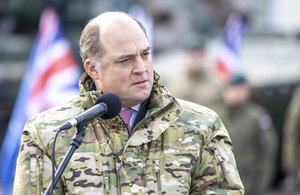
Defence Secretary in Olsztyn, Poland.
I have lost count of how many times recently I have to had to explain the meaning of the English term “straw man” to my European allies. That is because the best living, breathing “straw man” at the moment is the Kremlin’s claim to be under threat from NATO. In recent weeks the Russian Defence Minister’s comment that the US is “preparing a provocation with chemical components in eastern Ukraine” has made that “straw man” even bigger.
It is obviously the Kremlin’s desire that we all engage with this bogus allegation, instead of challenging the real agenda of the President of the Russian Federation. An examination of the facts rapidly puts a match to the allegations against NATO.
First, NATO is, to its core, defensive in nature. At the heart of the organisation is Article 5 that obliges all members to come to the aid of a fellow member if it is under attack. No ifs and no buts. Mutual self-defence is NATO’s cornerstone. This obligation protects us all. Allies from as far apart as Turkey and Norway; or as close as Latvia and Poland all benefit from the pact and are obliged to respond. It is a truly defensive alliance.
Second, former Soviet states have not been expanded ‘into’ by NATO, but joined at their own request. The Kremlin attempts to present NATO as a Western plot to encroach upon its territory, but in reality the growth in Alliance membership is the natural response of those states to its own malign activities and threats.
Third, the allegation that NATO is seeking to encircle the Russian Federation is without foundation. Only five of the thirty allies neighbour Russia, with just 1/16th of its borders abutted by NATO. If the definition of being surrounded is 6% of your perimeter being blocked then no doubt the brave men who fought at Arnhem or Leningrad in the Second World War would have something strong to say about it.
It is not the disposition of NATO forces but the appeal of its values that actually threatens the Kremlin. Just as we know that its actions are really about what President Putin’s interpretation of history is and his unfinished ambitions for Ukraine.
We know that because last summer he published, via the official Government website, his own article “On the Historical Unity of Russians and Ukrainians”. I urge you to read it, if you have time, because while it is comprehensive on his arguments it is short on accuracy and long on contradictions.
We should all worry because what flows from the pen of President Putin himself is a seven-thousand-word essay that puts ethnonationalism at the heart of his ambitions. Not the narrative now being peddled. Not the straw man of NATO encroachment. It provides the skewed and selective reasoning to justify, at best, the subjugation of Ukraine and at worse the forced unification of that sovereign country.
President Putin’s article completely ignores the wishes of the citizens of Ukraine, while evoking that same type of ethnonationalism which played out across Europe for centuries and still has the potential to awaken the same destructive forces of ancient hatred. Readers will not only be shocked at the tone of the article but they will also be surprised at how little NATO is mentioned. After all, is NATO ‘expansionism’ not the fountain of all the Kremlin’s concerns? In fact, just a single paragraph is devoted to NATO.
The essay makes in it three claims. One: that the West seeks to use division to “rule” Russia. Two: that anything other than a single nation of Great Russia, Little Russia and White Russia (Velikorussians, Malorussians, Belorussians) in the image advanced in the 17th Century is an artificial construct and defies the desires of a single people, with a single language and church. Third, that anyone who disagrees does so out of a hatred or phobia of Russia.
We can dispense with the first allegation. No one wants to rule Russia. It is stating the obvious that just like any other state it is for the citizens of a country to determine their own future. Russia’s own lessons from such conflicts as Chechnya must surely be that ethnic and sectarian conflicts cost thousands of innocent lives with the protagonists getting bogged down in decades of strife.
As for Ukraine, Russia itself recognised the sovereignty of it as an independent country and guaranteed its territorial integrity, not just by signing the Budapest Memorandum in 1994 but also its Friendship Treaty with Ukraine itself in 1997. Yet it is the Kremlin not the West that set about magnifying divisions in that country and several others in the Europe. It has been well documented the numerous efforts of the GRU and other Russian agencies to interfere in democratic elections and domestic disputes is well documented. The divide and rule cap sits prettiest on Moscow’s head not NATO’s.
Probably the most important and strongly believed claim that Ukraine is Russia and Russia is Ukraine is not quite as presented. Ukraine has been separate from Russia for far longer in its history than it was ever united. Secondly the charge that all peoples in Belarus, Russia and Ukraine are descendants of the ‘Ancient Rus’ and are therefore somehow all Russians. But in reality, according to historian Professor Andrew Wilson in his excellent essay for RUSI entitled “Russia and Ukraine: ‘One People’ as Putin Claims?” they are at best “kin but not the same people”. In the same way Britain around 900AD consisted of Mercia, Wessex, York, Strathclyde and other pre-modern kingdoms, but it was a civic nation of many peoples, origins and ethnicities that eventually formed the United Kingdom.
If you start and stop your view of Russian history between 1654 and 1917 then you can fabricate a case for a more expansive Russia, perhaps along the lines of the motto of the Russian Tsar before the Russian Empire “Sovereign of all of Rus: the Great, the Little, and the White” – Russia, Ukraine and Belarus respectively. And crucially you must also forget the before and after in history. You must ignore the existence of the Soviet Union, breaking of the Russian-Ukrainian Friendship Treaty, and the occupation of Crimea. Far more than footnotes in history, I am sure you will agree.
Ironically, President Putin himself admits in his essay that “things change: countries and communities are no exception. Of course, some part of a people in the process of its development, influenced by a number of reasons and historical circumstances, can become aware of itself as a separate nation at a certain moment. How should we treat that? There is only one answer: with respect!” However, he then goes on to discard some of those “historical circumstances” to fit his own claims.
Dubious to say the least, and not in anyway a perspective that justifies both the occupation of Crimea (in the same way Russia occupied Crimea in 1783 in defiance of the Russo-Turkish Treaty of Kuchuk-Kainarji in 1774) or any further invasion of modern Ukraine, as an independent sovereign country.
The last charge against the West by many in the Russian Government is that those who disagree with the Kremlin are somehow Russophobes. Leaving aside that GRU officers deployed nerve agents on British streets or that cyber hacking and targeted assassinations emanate from the Russian state, nothing could be further than the truth.
Russia and the UK share a deep and often mutually beneficial history. Our allegiances helped to finally defeat Napoleon and later Hitler. Outside of conflict, across the centuries we shared technology, medicine and culture. During the 18th Century Russia and Britain were deeply tied. Between 1704 to 1854, from age of Peter the Great through Catherine the Great and well into the 19th Century the British were to be found as admirals, generals, surgeons, and architects at the highest level of the Russian Court. The father of the Russian Navy – one Samuel Greig – was born in Inverkeithing in Fife.
That shared admiration is still true today. The British Government is not in dispute with Russia and the Russian people – far from it – but it does take issue with the malign activity of the Kremlin.
So, if one cold January or February night Russian Military forces once more cross into sovereign Ukraine, ignore the ‘straw man’ narratives and ‘false flag’ stories of NATO aggression and remember the President of Russia’s own words in that essay from last summer. Remember it and ask yourself what it means, not just for Ukraine, but for all of us in Europe. What it means the next time…