

25 Oct 24. Scotland-based SME Zelim has won a contract with the US Navy to deploy their innovative AI-enabled Person-in-Water detection and tracking technology, known as ZOE.
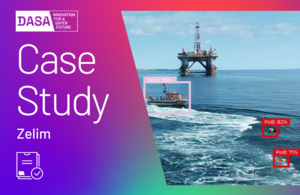
- Zelim’s detection and tracking system uses AI to scan the water surface to find people in the water much more accurately and consistently than human eyes and current systems can
- Low-cost and easy to integrate, the software solution can be implemented in any camera or CCTV setup
- DASA funding has helped take the solution from concept to commercial project, which is now being used on commercial ships, offshore energy infrastructure and commercial ports
- In 2024, Zelim was awarded a US Navy contract to deploy ZOE – their advanced AI-enabled person in water detection and tracking technology
In 2024, Edinburgh-based SME Zelim achieved a remarkable milestone: securing a contract with the US Navy to deploy an advanced Person-in-Water detection system. This breakthrough, rooted in artificial intelligence, represents a significant leap forward in maritime rescue technology – and it all began with support from the UK’s Defence and Security Accelerator (DASA).
The US Navy contract, awarded through a Phase I SBIR (Small Business Innovation Research) program, recognises Zelim’s cutting-edge AI-enabled detection and tracking technology. This system, known as ZOE, can scan vast stretches of ocean, identifying and tracking individuals or objects with unprecedented accuracy – even in challenging conditions that would confound human observers and current vision systems.
How did a small Scottish company attract the attention of the US Navy? In 2022, Zelim presented the search and rescue concept to the DASA Open Call, which offered essential early-stage funding and expertise, allowing Zelim to turn their idea into reality. Zelim’s DASA project helped the SME tackle significant challenges, such as gathering person in water rescue data across a huge range of conditions and creating a comprehensive database for accurately identifying humans in water – a critical component in making the system reliable enough for real-world rescue operations.
Andy Tipping, Co-Founder and Business Development Director explains:
The DASA offering is unique, we had a DASA Subject Matter Expert who was always on hand to keep us on track and to make sure whatever we developed would meet defence customer needs, plus we had an Exploitation Manager working tirelessly to secure meetings with a range of MoD and Home Office end users. The result was, by the end of the project we started securing our first contracts in civilian markets, selling our AI enabled detection system to offshore energy operators and several months later our technology was selected for the US Navy SBIR programme. Being a DASA Alumni also gave credibility and it wasn’t long after the project completed that we secured our Series A investment round.
From UK Innovation to US Navy Contract
As soon as someone enters the water, rescuers are against the clock. This is greatly understood by Zelim founder, Sam Mayall, a seasoned mariner with a wide range of experience, from small dinghies to 40,000-ton ships. With a background in commercial shipping, Sam has experienced numerous emergencies at sea, including a tragic incident where rescuers discovered a body floating face down in the water.
This experience ignited the desire to help improve maritime safety for sailors and equip rescuers with better tools, enhanced by AI and automation to ensure safer operations in the vast ocean and help overcome challenges such as:
-
Vastness of Oceans
Individuals lost at sea can be difficult to spot with only their head often visible, which can be missed or confused with other ocean debris.
-
Poor Weather Conditions
Fog, ocean spray, and darkness significantly reduce visibility, complicating the search efforts.
-
Imperfect Human Eyesight
Human vision is fallible; fatigue and level of concentration can lead to false detections and missed rescue opportunities.
-
Reliance on Binoculars or CCTV
During the critical period, rescuers using only binoculars or viewing camera streams may struggle to keep sight of the individual as they disappear behind waves, sea spray and other vessels
-
Parallax Effect
The difference in movement speeds between foreground and background can confuse existing vision systems.
Charting new waters with ZOE
Zoe works by scanning the sea surface, sifting through the busy marine surroundings to pinpoint individuals or specific objects. These targets can then be recognised, identified, and tracked using their unique AI software.
A key advantage of ZOE is its flexibility in accounting for the dynamic and chaotic nature of the sea, avoiding false positives from objects like buoys by analysing live daylight and thermal camera feeds for human-like patterns. Zelim spent several years compiling a comprehensive data library to ensure reliable identification, solving the last piece of the puzzle for effective ocean rescue.
Additionally, ZOE is software-based and hardware agnostic, applicable to any camera or CCTV feed, making it ideal for commercial shipping, passenger vessels, naval ships, search and rescue aircraft and ports.
How Zelim’s innovation can bolster search and rescue
- Compatible with various camera systems
- Alerts users to humans in water with 96% accuracy from 300 meters
- Operates effectively in adverse weather and low light
- Automatically tracks spotted individuals, preventing loss
- Easy-to-install software managing multiple feeds, with local data processing
- More efficient than traditional methods like binoculars and standard sensors
Breaking into defence and civilian markets: What does the future hold for Zelim?
DASA support proved invaluable for Zelim. By the end of the DASA project, Zelim had not only created a working prototype but had also begun securing their first contracts in civilian markets, including:
- Jack-up drilling rigs in the North Sea
- A floating wind farm off the coast of Portugal owned by Ocean Winds
- A cruise ship
The effectiveness of Zelim’s solution was evident during field trials, demonstrating its accuracy, measurability, and consistency. The system can achieve 96% accuracy from over 330 meters without applying optical zoom, and with optical zoom, it can spot humans in the water over a kilometre away.
These capabilities caught the attention of defence organisations worldwide. In addition to the US Navy contract, Zelim’s technology was also deployed in a Royal Canadian Air Force search and rescue exercise in 2024, where it demonstrated its ability to find and track humans at sea with no false positives.
The company’s growth reflects its success. Starting the DASA project with just 10 employees, Zelim has now expanded to a team of 28, with further growth anticipated as they work to fulfill the US Navy and offshore energy contracts.
Looking ahead, Zelim plans to increase deployment of their technology on ships, major global ports, search and rescue assets, and air assets. This ambitious growth strategy underscores the far-reaching impact of DASA’s initial support – from fostering UK innovation to enhancing global maritime safety and creating economic opportunities.
The US Navy contract stands as a testament to the power of targeted innovation support. By backing Zelim’s vision, DASA has not only contributed to advancing a innovative UK technology but has also opened doors for a British SME on the global stage, demonstrating how investment in innovation can yield significant returns for both national security and prosperity.